Online
Russian
Classes
Learn Russian in individual online lessons, with a program tailored to your level, interests and goals.






Trial Lesson
To book a trial lesson, sign up and pay $8.00.
The trial lesson is one-on-one and lasts 45 minutes.

Lesson Package
If you enjoyed the trial lesson, you need to purchase a lesson package by prepaying for at least 4 lessons.
The price of a 4-lesson package is $60.00 (one lesson costs $15.00).
Payment must be made at least 24 hours before the lesson starts.

Discounts
When you purchase 8 lessons or more, a discount applies. The more lessons, the more you save!
Course Overview
The online Russian course is suitable for children aged 5 and older, as well as adults of any age. You can start from scratch, follow the school curriculum or develop a bilingual child’s Russian. If you already speak the language, your teacher will help you improve your accuracy and your spoken and written Russian.
The program includes preparatory, beginner, intermediate and advanced levels. We choose the right stage based on your knowledge and goals.
Private lessons last 45 minutes and take place in real time on Google Meet or Zoom. We agree on the schedule in advance. If needed, explanations can be given in Russian, Ukrainian or English — we choose the language of communication with the teacher before lessons begin.
Our teachers are native Russian speakers with a degree in the subject and experience teaching children and adults.
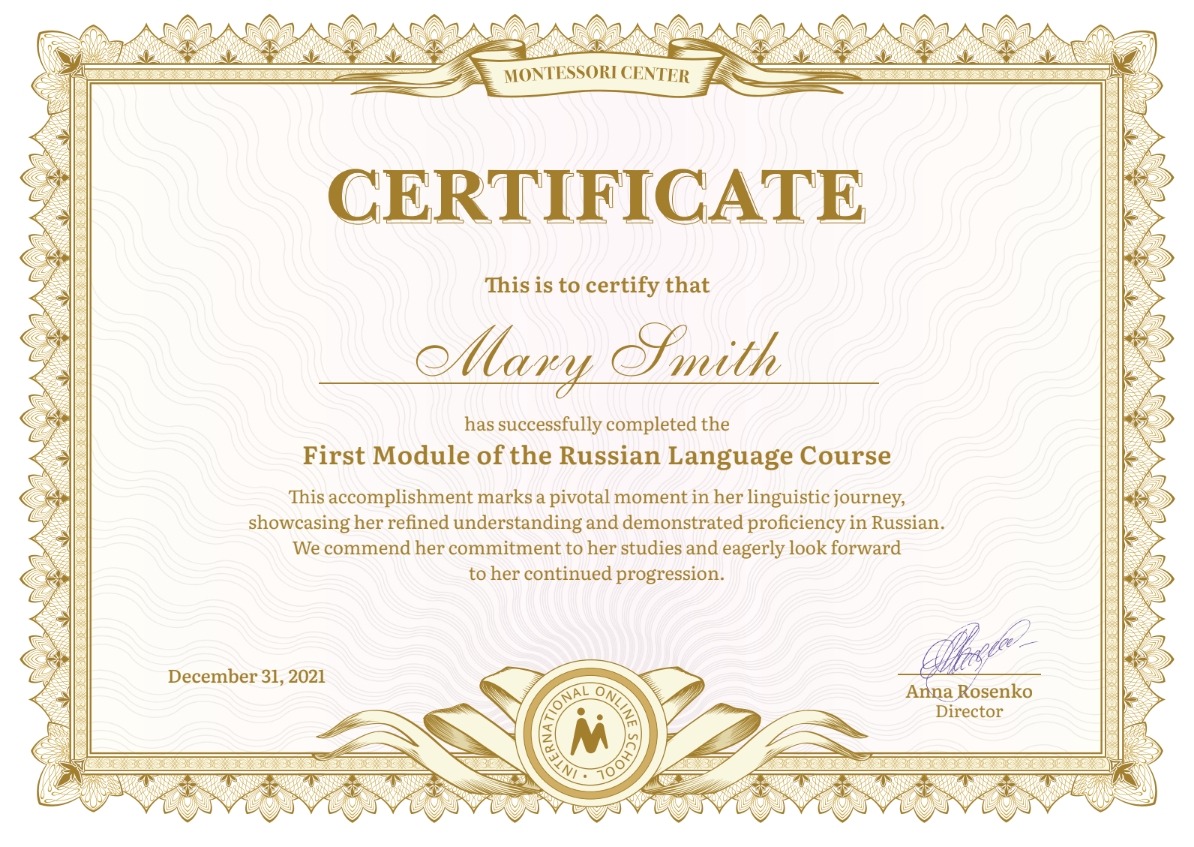
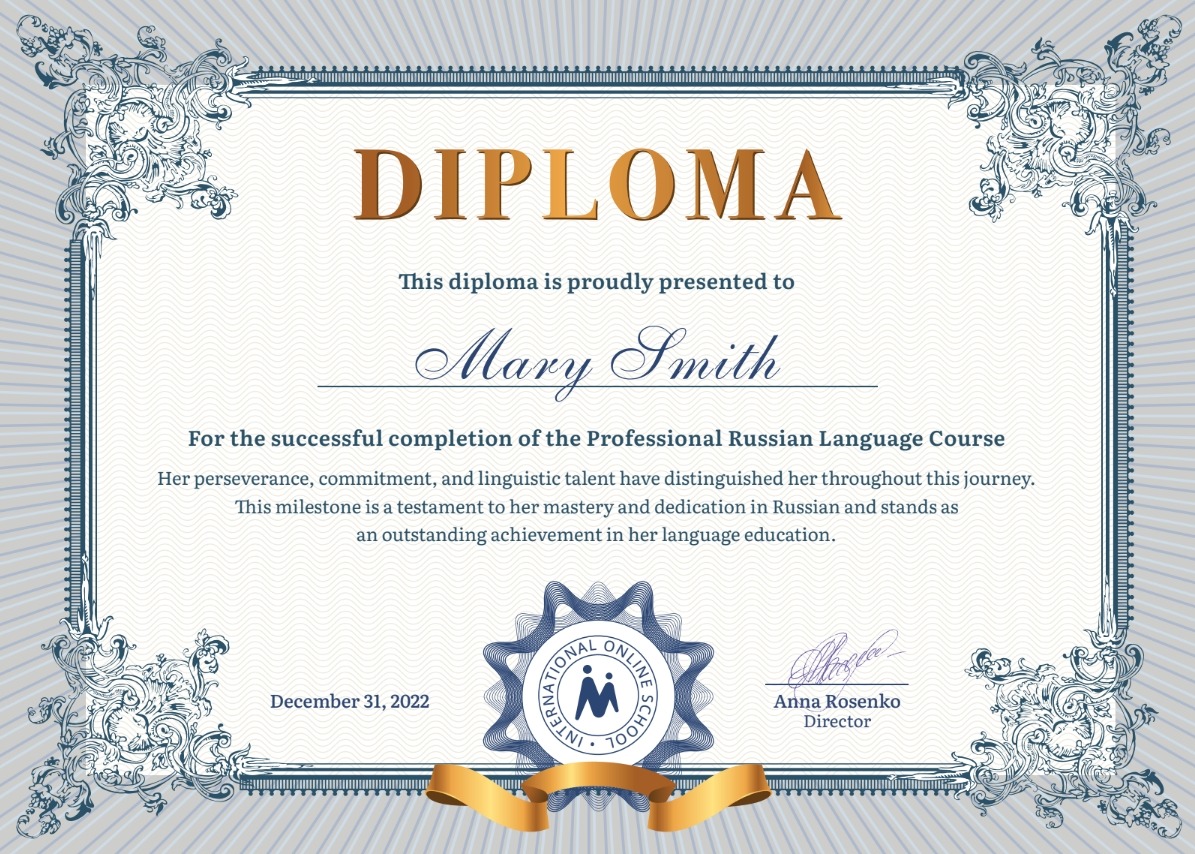
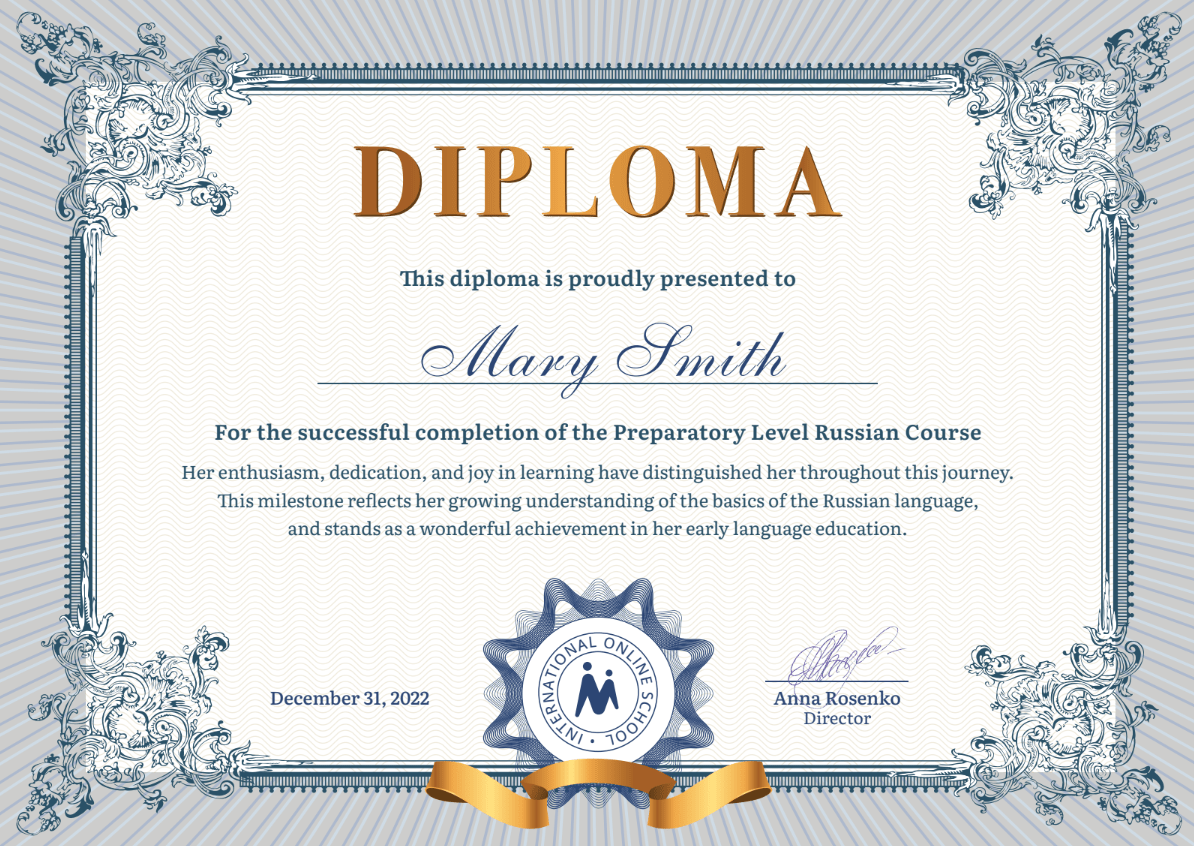
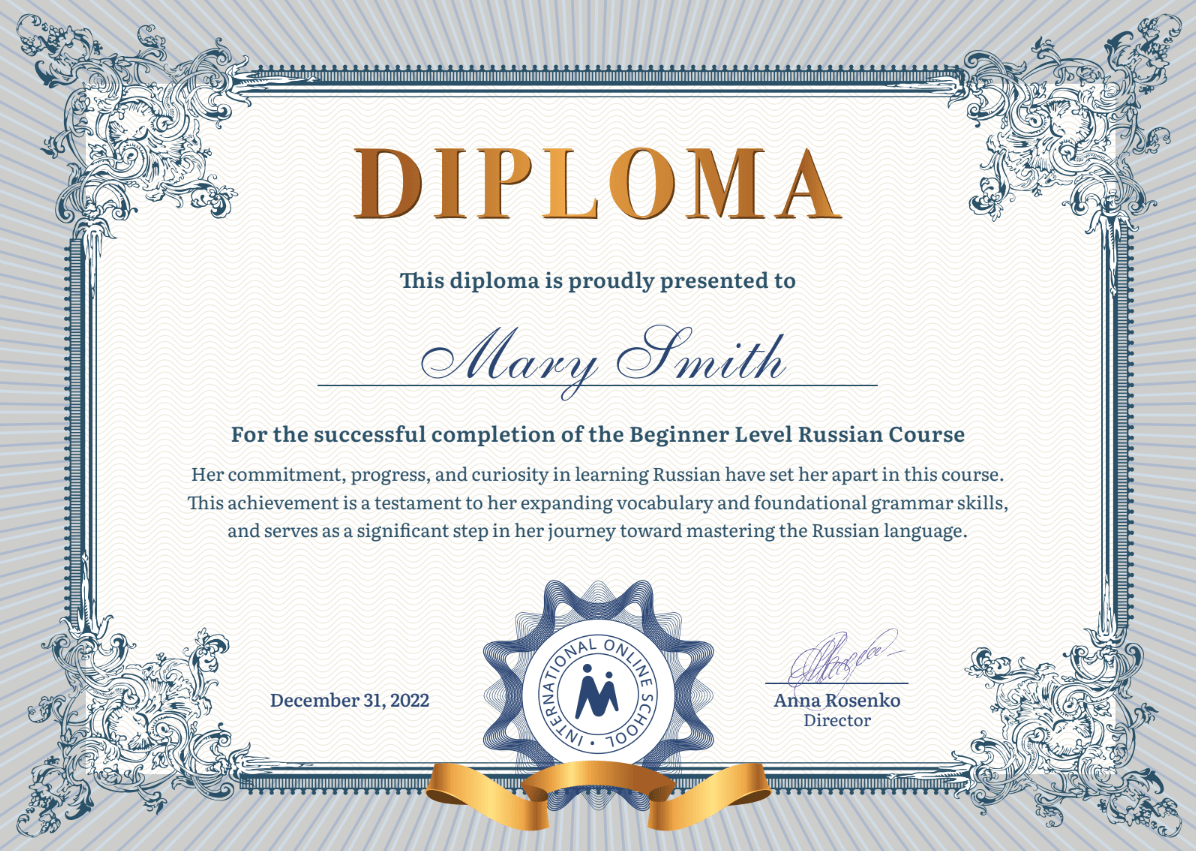
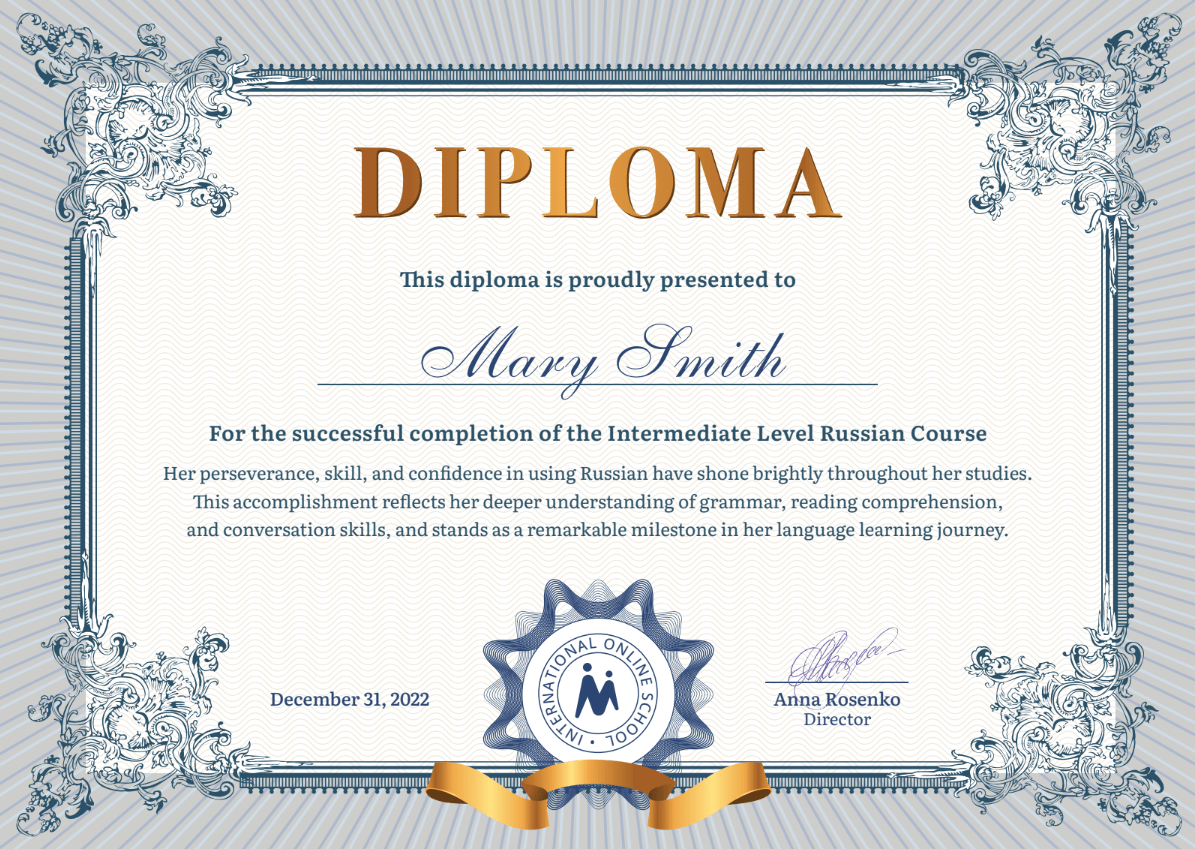
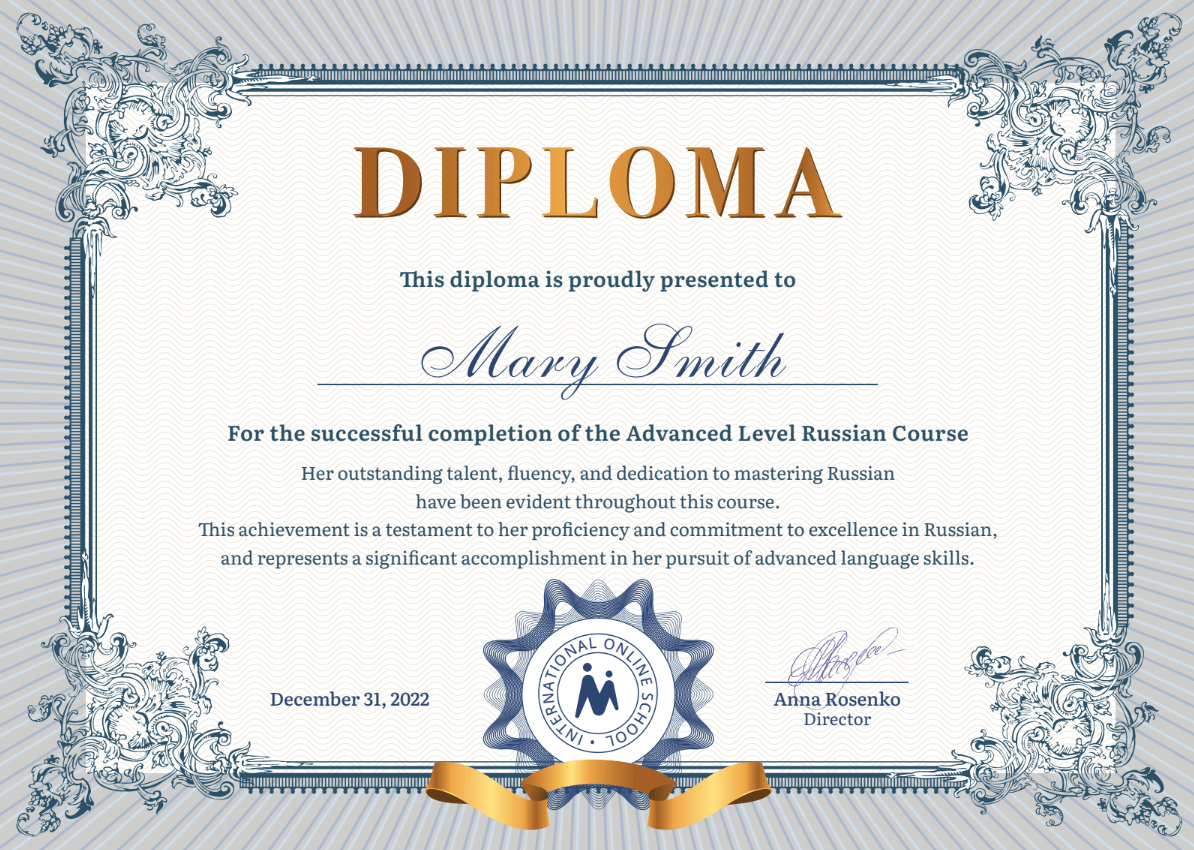
We recommend two lessons a week, with homework between lessons. You can discuss lesson frequency with your teacher or our administrator. Students receive a school diploma after completing each level: beginner, intermediate and advanced.
Teaching Methodology
The teacher explains a new topic with examples, building on what the student already knows. Then the student applies the rule: completing a sentence, correcting a mistake, making up a dialogue or writing a short text. Unfamiliar words are explained in context so that it is clear when and how to use them.
We revisit what students have learned in later tasks. The teacher checks whether the student can use the material independently and suggests review when needed. Progress is assessed through spoken answers, written work and short tests.
Advantages of the Methodology
1. Working on your difficulties: you can take a closer look at a specific school topic, review a forgotten rule or practice a skill you need for communication.
2. Individual pace: you move faster through familiar material and spend as much time on difficult points as you need to understand them.
3. Feedback: the teacher explains the cause of a mistake and shows you how to check yourself in a similar task.
4. Age and interests: children and adults are offered different texts, conversation topics and writing assignments.
5. Continuing your studies: after completing the chosen program, you can set new goals — for example, moving from everyday conversation to business correspondence or more complex texts.
Preparatory Level
Students learn the sounds and letters of Russian and begin to understand simple questions. They learn words on familiar topics: family, home, activities and everyday objects. They try answering in short phrases and taking part in simple dialogues.
If a child cannot read yet, the teacher combines speaking tasks with pictures, word games and letter recognition exercises, then gradually moves on to reading syllables and short words.
Beginner Level
Students learn to build simple sentences, ask questions and talk about themselves. They work through basic grammar rules, practice pronunciation and stress, and expand their vocabulary for everyday communication.
The program includes short texts, dialogues, listening comprehension exercises and writing tasks. Students try writing a message on their own, describing an object or retelling a short story.
Intermediate Level
More time is given to connected speech: students describe events in detail, explain their point of view and discuss what they have read. They learn to build complex sentences and choose words that convey their meaning more precisely.
In written work, they learn to present their thoughts in a logical order, divide a text into paragraphs and check spelling and punctuation. They listen to dialogues and audio recordings, answer questions and discuss what they have heard.
Advanced Level
Students work with texts in different styles, discuss topics that call for a detailed answer, and learn to support their arguments and express their thoughts precisely. They look at shades of meaning, set expressions and difficult points of grammar.
Depending on their goals, students can focus more on essays, business correspondence, presentations or academic texts. The teacher helps them edit their own work: correcting mistakes, refining wording and choosing the right style.
Course Goals
Grammar: understand how sentences are built, use word forms correctly and apply the rules in your own answers and texts.
Vocabulary: expand your vocabulary, distinguish between words with similar meanings and choose expressions that suit the situation.
Speaking: keep a conversation going, ask questions, talk about events and explain your point of view.
Reading and listening comprehension: understand the meaning of a text or conversation, find the information you need and notice important details.
Writing: express your thoughts accurately and coherently, write messages, letters and other texts, and find and correct mistakes.
Test and exam preparation: review the necessary topics, work through typical tasks and become familiar with the requirements of the chosen format.
Benefits of Online Russian Language Lessons
More independence in your studies: being able to read a task carefully, understand the question and put together an answer helps with schoolwork. In lessons, you can work on the specific topics you find difficult.
Keeping the language alive in the family: for bilingual children, lessons are another opportunity to speak, read and write in Russian. Their vocabulary gradually grows beyond everyday conversations at home.
Everyday communication: students learning Russian as a foreign language can practice making requests, clarifying information, talking about themselves and understanding the other person’s replies.
Reading for pleasure: as you progress, it becomes easier to choose books and articles, understand videos and discuss them. Your teacher helps you find materials at the right level that make you want to keep going.
In your trial lesson, you will meet your teacher and discuss your or your child’s goals for online Russian lessons. Short speaking and writing tasks will help decide where to start and what to focus on.
News


How Russian Lessons Are Conducted
Device for lessons: a computer or tablet with a camera and microphone is more convenient — a larger screen makes reading texts and completing tasks easier. A smartphone will also work if you do not have another device.
Internet connection: check your connection before the lesson. It is important to hear each other clearly: you will be speaking, listening to explanations and practicing pronunciation.
Lesson platform: lessons take place via Zoom or Google Meet. Open the meeting link in advance. If necessary, install the app and allow access to your camera and microphone.
Sound: choose a quiet place where you can speak freely without distractions. Headphones with a microphone will help you hear your teacher more clearly. Check that everything works before the lesson begins.
Study space: clear room for a notebook and have a pen ready. Position your screen at a comfortable height and adjust the lighting so your face is visible and you can read and write easily.
Lesson link: we will send it in advance by email or through a messaging app. If you cannot find the message before your lesson, contact the administrator.
Materials: have everything ready so you can focus on your teacher’s explanations:
Before joining:
Explanations and feedback: your teacher will explain the topic using clear examples and suggest tasks to reinforce what you have learned. If you make mistakes, they will explain why and help you find the correct answers.
Questions: if a rule is unclear or you find it difficult to answer, ask for an explanation. You can revisit a difficult point and work through a few more examples.
Practice: you will read, write, discuss texts and practice dialogues. The tasks will depend on your goal: improving your spelling and grammar, working through the school curriculum or learning to communicate in Russian.
Speaking skills: your teacher will demonstrate how to pronounce an unfamiliar word, place the stress correctly and form a phrase. You will try using new words in conversation to help you remember their meaning and usage.
Lesson review: at the end, you will discuss what you have learned and what still needs attention. Your teacher will explain your homework and how to complete it on your own.
Materials for independent practice: your teacher will send exercises and texts to review the topic covered. If needed, they will suggest audio or video materials to reinforce new vocabulary and practice listening comprehension.
Join our online Russian lessons! We’ll help you choose the right program for you or your child and find a convenient time.
Russian Language Teachers

Liliya Yarmolenko
Russian, English, Ukrainian, Spanish, Japanese

Irina Zvershkovskaya
Russian
Russian Course Curriculum
 Preparatory
level
Age: 5–6 years
Modules
Introduction to Russian: greetings, numbers, colors, and the names of familiar objects. Children listen to and repeat words and short phrases, learn simple songs and poems, and play games to help them remember new words.
Speaking skills: understanding short questions and responding with simple words and phrases. Children learn to talk about themselves and have short conversations with their teacher.
First steps in reading: an introduction to Russian letters and sounds. Children learn to match letters to sounds and read syllables and simple words, gradually progressing to short sentences.
First steps in writing: tracing and writing letters, followed by copying simple words. Flashcards and coloring sheets are used to review letters and words. Tasks are selected to suit each child’s readiness for writing.
 Beginner
level
Age: 7 years and older
Modules
Vocabulary development: topics include “My Family,” “My Friends,” “Animals,” “Food,” and “Toys.” New vocabulary is reinforced through games, exercises, and short dialogues.
Words and sentences: words that name things, actions, and qualities. Students learn to use questions to identify word types, form simple sentences, and put words in the correct order.
Reading comprehension: short stories, fairy tales, and poems. Students answer questions about the content, find relevant information, and learn to retell short passages.
Writing tasks: copying words and sentences and giving short written answers to questions. Students gradually progress to describing objects and writing stories a few sentences long.
Speaking skills: dialogues with the teacher, language games, and storytelling using pictures. Students learn to ask questions, give full answers, and recount events in sequence.
Grammar and spelling: noun gender and number, and word agreement within sentences. Students learn to choose word endings, capitalize names, and use punctuation at the end of sentences.
 Intermediate
level
Age: 10 years and older
Modules
Grammar: verb tenses, noun declension, and the use of prepositions. Students learn to apply agreement rules, choose the correct word endings, and build simple and complex sentences.
Reading and text analysis: short stories, fairy tales, and informational texts. Students identify the topic and main idea, find key details, create an outline, and retell what they have read.
Writing tasks: written retellings, short compositions, and descriptions. Students learn to express ideas coherently, organize their writing into paragraphs, and check their work.
Listening comprehension: listening to stories, fairy tales, and songs. Students answer questions, identify relevant information, and briefly summarize what they have heard.
 Advanced
level
Age: 12 years and older
Modules
Speaking skills: discussing books, films, and current topics with the teacher and preparing talks and presentations. Students learn to support their opinions, give examples, and express their ideas coherently.
Grammar and punctuation: simple, compound, and complex sentences, coordinated sentence elements, and direct speech. Students analyze examples, explain punctuation choices, and correct grammatical errors.
Reading adapted and authentic texts: fiction, articles, and popular science materials. Students discuss the main ideas and the author’s viewpoint, learn to interpret subtext, and support their conclusions with examples from the text.
Writing assignments: compositions, articles, book reviews, and small research projects. Students learn to plan their work, present arguments, and edit their writing. When preparing for international Russian language exams, they review the format and work through sample tasks.
The Russian course curriculum for bilingual children covers speaking, reading, writing, grammar, and spelling. Children expand their vocabulary and reinforce what they have learned through exercises, games, and creative tasks. The material gradually becomes more challenging, progressing from short phrases and simple texts to discussions, retellings, and independent writing assignments.
Book a trial Russian lesson!
Course Schedule
We teach every day, including weekends
To coordinate the day of the week and the time for your lesson, please write to us, and the administrator will arrange a convenient schedule for you!Contact Us



Student Reviews of the Course
Tamara

Roman Klimov
Ulyana
Daniil
Carlos
Лариса
Review language: Russian
Марина
Review language: Russian
Диана
Review language: Russian
Виктория
Review language: Russian
Светлана Войчук
Review language: Russian
Frequently Asked Questions (FAQ)
Helpful Articles
Advantages of Immersion in an Online Language Environment
When a family lives abroad, Russian is the child’s home language, while the local language is the language of school...

The JCUKEN Layout: How the Russian Keyboard Works
Today Russian is not only spoken and handwritten but also typed a great deal, so anyone learning the language sooner...

Russian for Children Abroad: Keeping the Family Language
In many families abroad, Russian is the language of home, while at school and with friends the child speaks another...

How to Motivate Yourself to Learn Russian Online: Tips
Starting a language is easy; sticking with it is harder. Motivation in second-language learning has been studied since the late...

Effective Methods for Learning Russian Online
There are many ways to learn Russian online: with a teacher, in apps, from books and videos. What works best...
Stress in Russian: Why It Keeps Moving
In Russian, stress can fall on any syllable and shift from one part of a word to another. For learners,...

Top 5 Mistakes When Learning Russian and How to Avoid Them
Children growing up abroad usually speak Russian fluently but with typical mistakes. Linguists describe their speech as a heritage language:...

How to Learn to Write Beautifully and Correctly in Russian
Many children abroad speak Russian but hardly ever write it: at school they have another language, another alphabet and other...

Artificial Intelligence in Learning Russian
AI tools have become an everyday part of language learning: you can chat with them, ask them to explain a...