Online
Flute
Classes
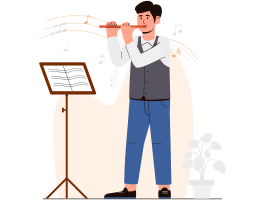
In our online flute course, you will learn your favorite melodies and prepare to perform at online concerts!


Trial Lesson
To book a trial lesson, sign up and pay $8.00.
The trial lesson is one-on-one and lasts 45 minutes.

Lesson Package
If you enjoyed the trial lesson, you need to purchase a lesson package by prepaying for at least 4 lessons.
The price of a 4-lesson package is $60.00 (one lesson costs $15.00).
Payment must be made at least 24 hours before the lesson starts.

Discounts
When you purchase 8 lessons or more, a discount applies. The more lessons, the more you save!
Course Overview
Our online flute course is suitable for children older than 7 and adults of all ages. During lessons, you will develop your playing technique, learn to read music and study classical pieces and modern melodies. The program includes beginner, intermediate and advanced levels. No musical experience is needed to start, while students who already play will receive material suited to their skill level.
Lessons are individual and last 45 minutes. You can study in Russian, Ukrainian or English. We agree on the schedule and teaching language before lessons begin.
Lessons take place in real time via Google Meet or Zoom. Your teacher demonstrates techniques on the flute, listens to your playing and helps you correct mistakes. Our teachers have higher education qualifications in music and teaching experience, and many perform in concerts as soloists and orchestral musicians.
We recommend taking two lessons a week with your teacher and practicing your assignments at home between lessons. You can perform prepared pieces at the school’s online concerts and competitions. Students receive a certificate after each module and a diploma after each level.
Our Teaching Approach
At the start of the course, the teacher gets to know the student and asks about their experience and musical interests. The teacher then selects exercises and pieces that allow technique to develop gradually. Beginners learn to hold the flute, develop their embouchure and hand position, work on breathing and play their first notes. Experienced students focus on tone quality, accuracy and more challenging repertoire.
We work through each new piece phrase by phrase, clarifying the notes, rhythm, fingerings, articulations and breathing points. Difficult transitions are practiced slowly before being played within a complete phrase. Once the notes and rhythms are secure, we focus more on dynamics, phrasing and musical character.
The teacher acknowledges progress at every lesson and explains what to practice at home. A prepared piece can be performed at an online concert or competition. Afterwards, the student and teacher discuss the result and decide on the next tasks.
Benefits of Our Teaching Approach
1. Clear tasks: the teacher explains what to work on in an exercise or piece and demonstrates how to improve tone, rhythm or the performance of a particular phrase.
2. Your own pace: students move on to new techniques and more challenging pieces as they master the material. More time can be spent on difficult passages.
3. Performance practice: preparing for online concerts and competitions helps students learn to perform a piece from beginning to end for an audience and manage performance nerves.
4. For children and adults: tasks, explanations and repertoire are tailored to the student’s age, skill level and musical preferences.
5. Continued learning: after completing the program, students can expand their repertoire, learn new techniques and refine their playing skills.
Beginner Level
At the beginner level, students get to know the flute and learn to hold it correctly. They develop their embouchure, learn proper breathing and understand basic fingering principles. Exercises help them produce a steady, clear tone.
Alongside this, students learn the basics of music notation: notes, note values, rests and rhythmic patterns. They learn short melodies and simple pieces and explore basic articulations. A chosen piece can be prepared for a first online performance.
Intermediate Level
At the intermediate level, students learn more challenging pieces and refine their technique. They work on finger agility, accurate transitions between notes, articulation and precise intonation. They learn to manage their breath throughout a phrase and vary dynamics while maintaining tone quality.
Greater attention is given to phrasing, musical character and playing with accompaniment. Students gradually learn to work through a score independently and prepare pieces for online concerts and competitions.
Advanced Level
At the advanced level, students work on challenging pieces in different styles. They improve finger dexterity, master combinations of articulations and develop accuracy at different tempos. Particular attention is given to tone across different registers, dynamics and musical phrasing.
Together with their teacher, students analyze the structure of a piece and make interpretive decisions: where to breathe, how to shape a phrase and how to highlight a climax. Knowledge of music theory and harmony helps them better understand the score and the characteristics of their chosen repertoire.
The program includes preparation for online concerts and competitions: rehearsing complete pieces, building performance confidence and discussing the results of performances.
Course Goals
Playing technique: learn to hold the flute correctly, develop a proper embouchure and hand position, and work on tone and precise finger movements.
Breathing: learn to control your airflow, manage your breath throughout a musical phrase and choose suitable breathing points.
Music reading: read notes and rhythmic patterns, understand tempo, dynamics and articulation markings, and work through simple pieces independently.
Repertoire: learn classical pieces and modern melodies, and explore music in different styles.
Expression: work on accurate intonation, phrasing and dynamics, and learn to convey the character of the music.
Playing with accompaniment: make accurate entries, maintain the tempo and hear how the flute part fits with the accompaniment.
Performance experience: prepare pieces for online concerts and competitions, learn to play for an audience and manage performance nerves.
Benefits of Flute Lessons
Precise movements: exercises help you change fingerings at the right moment and move between notes without unnecessary tension. Gradually, finger movements become more confident and your playing becomes clearer.
Musical ear: during lessons, you learn to listen to yourself, notice intonation inaccuracies and correct mistakes. Your teacher’s examples help you understand the result you are working toward.
Sense of rhythm: working with note values, rests and accents helps you play melodies more accurately. Playing with a metronome and accompaniment teaches you to maintain a steady tempo.
Independence: home practice teaches you to organize your time, identify difficult passages and choose ways to practice them. Your teacher helps you gradually learn to do this without constant guidance.
Performance confidence: a piece you have learned allows you to hear your own progress. Rehearsals and online performances help you get used to playing for an audience and continuing after a small mistake.
Creative practice: during lessons, you can experiment with different articulations, dynamics and phrasing, compare interpretations and choose the one that best conveys the character of the piece.
Exploring music: new repertoire gives you opportunities to discover composers and performers, listen to different interpretations of pieces and find melodies you want to play.
At your first lesson, you will meet your teacher and discuss your musical interests. Beginners will be shown how to hold the flute and given their first exercises. If you already play, a trial lesson will help identify which skills to develop and which pieces to start with.
News


How Flute Lessons Are Conducted
Equipment: prepare your flute and a device for video calls — a computer or tablet with a camera and microphone. Position the device so that your teacher can see your face, both hands and the entire flute, and you can comfortably view the screen.
Internet connection: check your connection before the lesson. A stable connection will help you hear your teacher’s explanations and playing without interruptions.
Lesson platform: lessons take place on Zoom or Google Meet. Check in advance that the link opens on your device. If necessary, install the app and allow access to your camera and microphone.
Sound: headphones will help you hear your teacher and musical examples more clearly. Check that the cable does not restrict your hand movements. At the beginning of the lesson, play a few notes so your teacher can check that both your flute and your voice can be heard clearly.
Lesson link: we will send it in advance. Before the lesson, check that you have received the message and that the link opens.
Sheet music: you will receive the lesson materials by email or via a messaging app. Print them and place them on a music stand, or open them on a screen where you can comfortably read them while playing.
Camera position: hold your flute and check the camera view. Your teacher should be able to see your face, upper body, both hands and the entire instrument. Position the screen so that you do not need to lean forward or turn your head.
Joining the lesson: follow the link to Zoom or Google Meet 5–10 minutes before the lesson starts. Check your camera and microphone, and have your flute and sheet music ready — this will leave time to resolve any technical issues.
Teacher’s guidance: your teacher will explain how to hold the flute, produce a sound and work on your breathing. As you play, they will point out where to adjust your intonation or check the notes or rhythm.
Questions: if an assignment is unclear or you find a technique difficult, ask for a more detailed explanation. You can work through a challenging passage with your teacher and try playing it again.
Practice: you will spend most of the lesson playing: practicing exercises, learning melodies and working on pieces. You will first repeat difficult passages slowly, then move on to playing complete phrases.
Playing demonstration: your teacher will play a passage on the flute so you can hear the tone, articulation and phrasing. If needed, they will demonstrate the fingering separately and explain where to breathe.
Wrapping up the lesson: together with your teacher, you will discuss what went well and what still needs work. Your teacher will suggest what to practice at home and what to focus on during independent practice.
For home practice, your teacher will select sheet music and exercises and explain what to review before the next lesson. If needed, they will send a recording of the piece, an accompaniment track or a video.
What melody would you like to play on the flute? Your teacher will help you choose a piece suited to your level and learn it step by step — from the first notes to playing the whole piece.
Flute Teachers

Anna Shakhova
Flute, Recorder

Anastasiia Antoniuk
Flute, Recorder

Anastasia Posmerega
Flute, Saxophone, Recorder
Anastasia Posmerega teaches saxophone, flute, and recorder at Montessori Center. She graduated with honors from the P. I. Tchaikovsky National Music Academy of Ukraine. A prizewinner at international competitions, she has also performed at concerts and festivals in Germany, Spain, France, Poland, and Italy.
Anastasia has attended masterclasses with Claude Delangle (France), Arno Bornkamp (the Netherlands), Jean-Denis Michat (France), Paweł Gusnar (Poland), and Ryszard Żołędziewski (Poland). She is a member of the women’s Queens Orchestra. Anastasia’s international performance experience enriches her online saxophone and recorder lessons with a broad repertoire and a variety of teaching approaches. Her students take part in competitions and win awards, perform at concerts, and attend masterclasses around the world. Anastasia teaches in Russian, Ukrainian, and English.Flute Course Program
 Beginner
level
Age: 7 years and older

Modules
Introduction to the flute: holding the instrument, embouchure and hand position. First exercises for breathing and tone production.
Music notation basics: notes, note values and rests. Learning fingerings and practicing simple exercises and melodies.
Learning basic articulation: playing slurred and separate notes. Sight-reading simple exercises.
Learning short pieces. Working on rhythm, accurate intonation and smooth transitions between notes.
Working on an even tone and breath control. Learning to play a complete musical phrase and breathe at the marked points.
Preparing to play a selected piece from beginning to end. Rehearsing and performing at an online concert.
 Intermediate
level
Age: 10 years and older

Modules
Developing expressive playing through phrasing, dynamics and the character of the flute’s tone.
Learning pieces in different styles. Working on their characteristic rhythms and articulation.
Playing along with recorded accompaniment. Working on precise entries, a steady tempo and coordination between the flute part and the accompaniment.
Preparing a concert program. Rehearsing and performing at an online concert, unaccompanied or with accompaniment.
 Advanced
level
Age: 12 years and older

Modules
Learning challenging pieces. Working on finger dexterity, precise transitions between registers and combinations of articulations.
Studying contemporary works for flute. Learning the playing techniques used in the selected repertoire.
Preparing a concert program: working on phrasing, dynamics and expressive playing. Rehearsing pieces from beginning to end.
Performing at an online concert or competition, unaccompanied or with accompaniment. Discussing the results with the teacher and choosing repertoire for further study.
The flute course is suitable for children aged 7 and over and adults of all ages. The program includes beginner, intermediate and advanced levels. Beginners can start from scratch, with no musical experience. For those who already play, the teacher will help select a program suited to their level. Students receive a diploma upon completing each level.
Book a trial lesson to meet your teacher and try playing your first notes on the flute. If you already play, your teacher will help identify which skills to develop and which pieces to start with!
Course Schedule
We teach every day, including weekends
To coordinate the day of the week and the time for your lesson, please write to us, and the administrator will arrange a convenient schedule for you!Contact Us


Student Reviews of the Course
Roberto


Sabine Roth
Thea Lindholm
Miriam Katz
Tomas
Umberto Greco
Simon Ashby
Rebeca
Дмитрий
Review language: Russian
Ирина Назаренко
Review language: Russian
Ольга Кузнецова
Review language: Russian
Татьяна Кузнецова
Review language: Russian
Дарья Кононова
Review language: Russian
Елена
Review language: Russian
Наталья С.
Review language: Russian
Наталя
Review language: Ukrainian
Ольга
Review language: Ukrainian
Лідія
Review language: Ukrainian
Андрій
Review language: Ukrainian
Олександр
Review language: Ukrainian
Frequently Asked Questions (FAQ)
Helpful Articles

Overcoming Stage Fright: Practical Tips for Flutists
Almost every musician knows pre-performance nerves. For a flutist, though, they are audible at once: the sound comes from the...

Flute Playing Styles: Classical, Jazz and Contemporary
The flute is heard most often in the orchestra, but its sound is just as recognizable in jazz, rock and...

Flutes of the World: Bansuri, Shakuhachi, Ney and Sopilka
Besides the orchestral transverse flute, many peoples have flutes of their own. Here are four of them, from India, Japan,...

The Flute’s History: From Antiquity to Modern Times
Few instruments are as old as the flute. Its story runs from Stone Age bone pipes to the silver concert...

Breathing Techniques for Flutists: Improving Your Sound
On the flute, sound is made of air: a stream of breath splits against the edge of the headjoint’s hole....

The Flute in Contemporary Music and Pop Culture
The flute is usually thought of as an orchestral, classical instrument. Yet its voice has turned up again and again...

Reading Music for Flutists: Basics and Methods
A flutist almost always plays from sheet music: in an orchestra, in an ensemble, at a competition. The good news...

Unusual Flute Techniques: Flutter-Tonguing and Harmonics
Beyond its ordinary playing, the flute has techniques that produce unusual sounds. They are known as extended techniques: unconventional ways...

Musical Improvisation on the Flute: Fundamentals and Techniques
Improvisation is music you make up while you play. It may seem to call for a special gift, but you...

Developing a Strong Musical Ear: Exercises for Flutists
A musical ear is not an all-or-nothing gift but a set of skills: recognizing pitch, intervals, melody, chords and rhythm...

Your Own Flute Sound: Vibrato, Articulation and Phrasing
Give the same piece and the same score to different flutists, and each will play it in their own way....

The Flute for Beginners: Your First Weeks of Lessons
The first weeks with a flute shape a lot: this is when posture, lip position and practice habits take hold....

Tips for Preparing for Music Competitions and Performances
A competition or concert is a goal that ties practice together: a piece has to be not just learned but...

Famous Flutists and Their Contribution to the Arts
Getting to know great flutists is the best way to hear what the instrument can do. Here are players who...

Exploring Different Types of Flutes: From Piccolo to Bass Flute
The flute is a whole family of instruments of different sizes and pitches. Their fingerings are similar, but they sound...

Flute Practice at Home: What a Good Session Includes
Between lessons, a flutist works alone. Here is how much to practice at first, what a home session can consist...

The Flute in the Orchestra: Seats, Parts and Famous Solos
In a symphony orchestra, flutes belong to the woodwind section, together with oboes, clarinets and bassoons. Here is where flutists...

Choosing and Caring for a Flute: Practical Tips
A first flute should above all be in good working order and comfortable; an expensive material is not needed at...

How to Memorize a Flute Piece: What Musical Memory Relies On
In Western classical music, playing from memory is a core part of a concert soloist’s professional skill. Below we look...

The Path to Perfection: Exercises for Developing Flute Technique
A flutist’s technique is made up of breath, tone, fingers and tongue. Each has its own exercises, and flutists play...
Gallery