The Ukrainian Alphabet: 33 Letters and How to Say Them
· Updated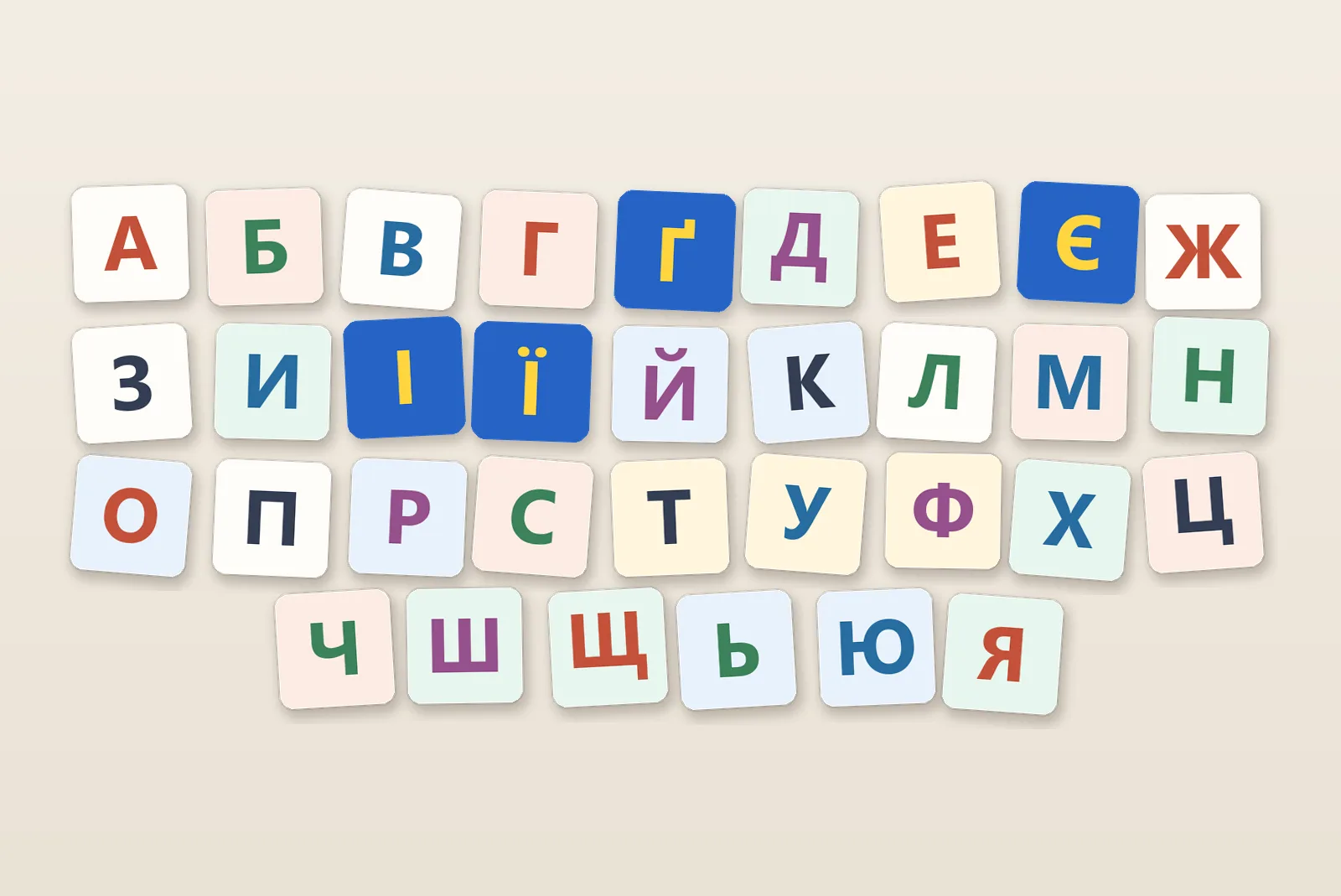
The Ukrainian alphabet is one of the national versions of Cyrillic. Some letters will look familiar if you know another Cyrillic alphabet, but Ukrainian has letters and reading rules of its own. Below is how many letters it has, which ones are special, how the soft sign and the apostrophe work and how children and adults can learn the alphabet.
How Many Letters There Are
The Ukrainian alphabet has 33 letters: 21 consonants, the semivowel й, 10 vowels and the soft sign. The apostrophe is required in writing but is not counted as a letter. Spelling largely follows pronunciation, so one letter usually stands for one sound. Ukrainians call the alphabet “abetka,” after its first two letters, а and б.
Special Letters
- Г is not the hard g of “go” but a breathy sound close to English h; the hard g has a separate, less common letter, Ґ.
- И and І are two different vowels: І sounds like the ee in “see,” while И is a shorter, more relaxed sound, close to the i in “sit.”
- Є is read as “ye,” and Ї as “yi.”
- Щ stands for two sounds at once, “shch.”
Iotated Letters
At the start of a word, after a vowel or after an apostrophe, Є, Ю, Я and Ї stand for two sounds, y plus a vowel: “юнак” (young man) begins with “yu,” and “яблуко” (apple) with “ya.” After a consonant, Є, Ю and Я soften it instead.
The Soft Sign and the Apostrophe
The soft sign appears only after consonants and softens them. Consonants also soften before є, і, ю and я. The apostrophe does the opposite and cancels softening: in ім’я (name), п’ять (five) and м’ята (mint), the consonant before я stays hard, and я is read as “ya.”
The mistakes Russian speakers make most often are covered in Common Mistakes Russian Speakers Make in Ukrainian.
How to Learn the Alphabet
- Start with the letters that make Ukrainian distinctive, Ґ, Є, І and Ї.
- Learn letters inside words and read them aloud right away.
- Children do well with cards, sound games and short rhymes. In our course, younger students begin with letters and sounds, games and pronunciation exercises, and then join letters into syllables and read short words.
How parents abroad can keep Ukrainian alive for their children is covered in Ukrainian for Children Abroad: Learning the Family Language.
Our Ukrainian Course
In our Ukrainian course, students study grammar, learn to hold a conversation and understand spoken language, build their vocabulary and write messages, letters and essays. The teacher assesses each student’s level and builds an individual program. Lessons are open to students from age 5. A trial lesson costs $8: it is individual and lasts 45 minutes. More about the course is on the Ukrainian page.


