Sounds of Home: Drum Practice Without Disturbing the Neighbors
· Updated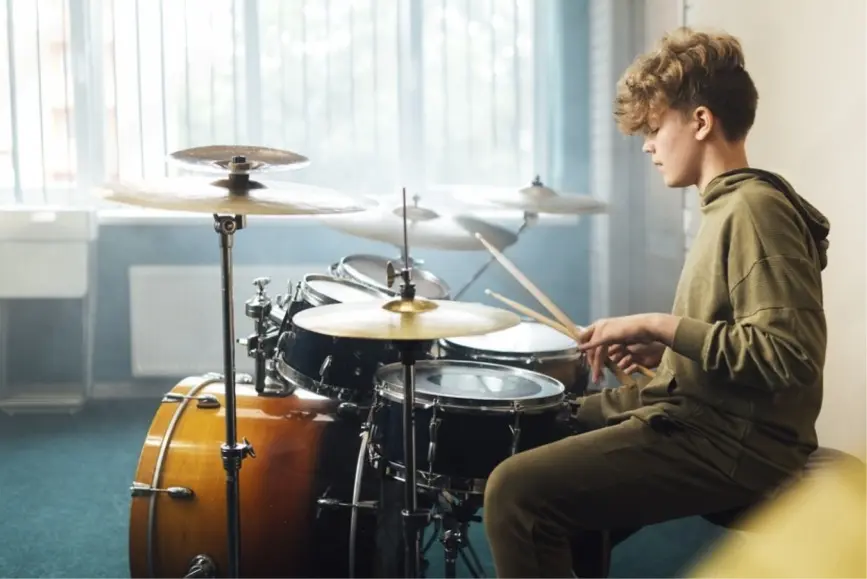
Drums are among the loudest instruments, and “what will the neighbors say?” is one of the first questions asked by both parents of young drummers and adult students. Practicing at home is possible: choose a kit that suits your space, make it quieter, and agree on practice times.
How Loud Drums Are
An acoustic drum kit is very loud. Researchers measured the noise at the ears of 21 drummers during a typical rehearsal: the overall level reached 103 dBA. The World Health Organization considers 85 dB for more than eight hours a day, or 100 dB for more than 15 minutes, unsafe for hearing. So quiet matters not only for the neighbors but for the student too.
Electronic Drums: Quieter, but Not Silent
An electronic kit has pads instead of drums and cymbals, and the sound goes to headphones or a speaker, so you can turn it down. That is why it is usually more convenient than an acoustic kit in an apartment. But hits on the pads, and especially on the bass drum pedal, can still be heard: the thumps travel through the floor to the neighbors below.
- Put the kit on a thick rug or a dense mat.
- Place vibration-absorbing boards under the pedals; electronic drum makers such as Roland produce them too.
- Ask someone in your family to listen from the next room during practice: you will quickly find out what can be heard through the wall.
How to Make an Acoustic Kit Quieter
- Mesh heads instead of regular ones, and low-volume cymbals: drummers use them where they cannot play loud.
- Rubber mutes on the drums and cymbals soften the sound.
- A practice pad: it is used to work on stick grip and first exercises, and it is much quieter than a drum.
Agree on Practice Times
Even a quiet kit can be heard. Check the rules of your building and city: many places have quiet hours in the evening and at night. Let your neighbors know that someone at home is learning to play the drums, and agree on when to practice. Regular practice at the same time during the day is easier for neighbors to accept than sudden noise late in the evening.
Protect Your Hearing
For practicing on an acoustic kit, musicians’ earplugs are useful. With electronic drums, do not turn the headphones up to the maximum: it is enough to hear the hits and the metronome clearly.
Online Lessons Happen at Home Too
In an online lesson, the teacher sees the student’s posture and hand and foot movements through the camera, and the student hears the explanations in headphones. A lesson lasts 45 minutes. What to prepare for a lesson is described on the Drums course page, and how to choose an instrument is covered in How to Choose Your First Drum Set. You can start with a trial lesson for $8.


