How to Choose Your First Drum Set
· Updated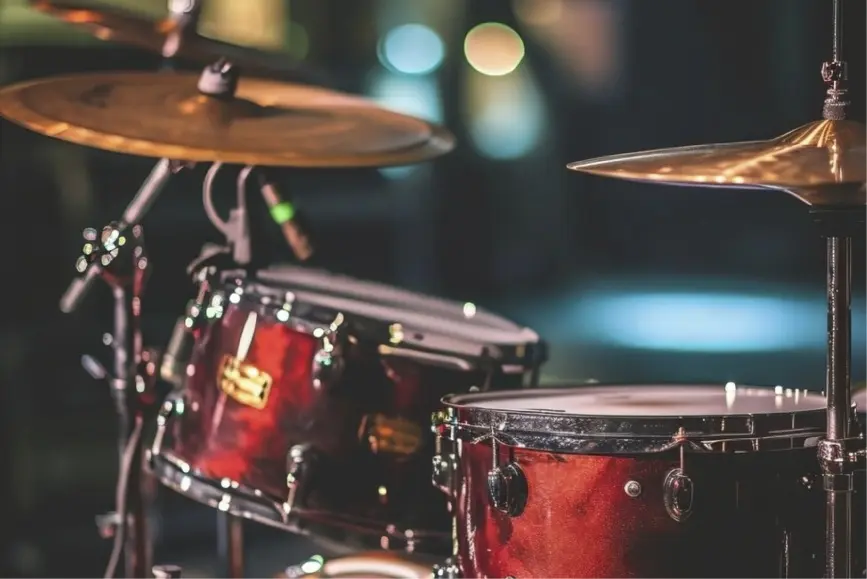
A first drum set is a noticeable purchase: it takes up room and it is loud. Here is what a kit is made of, how acoustic and electronic kits differ, what to check before you buy and what you will need for online lessons.
What a Drum Set Includes
There is no single standard, but most kits have a stand-mounted snare drum, a pedal-operated bass drum, two or more toms, ride and crash cymbals, and a hi-hat, a pair of cymbals you can play both with the sticks and with a pedal. Kits are named by the number of drums, without counting the cymbals. The most common full-size setup is the five-piece, with three toms.
Smaller sets exist too: a snare, a bass drum, a hi-hat and one cymbal. For children, a three-piece kit is a common choice, and scaled-down kits are made for the youngest players. Still, look at height rather than at a “kids” label: a child should be able to reach every pedal, drum and cymbal without strain.
Acoustic or Electronic
On an acoustic kit, the sound comes straight from hitting the drums and cymbals, with no electronics involved. From the first lessons you hear how the sound changes with the force and spot of each stroke, but a kit this loud does not fit every home, so check that you have a room for regular practice before you buy. Acoustic drums also have to be tuned, and the stands and pedals set up to fit the player.
An electronic kit is a set of pads and a sound module: sensors in the pads send each hit to the module, which plays the chosen sound through headphones or an amplifier. The pads themselves make little noise beyond the tap of the sticks, and mesh pads feel closer to a real drum. Even so, an electronic kit is never completely silent; how to practice without bothering the neighbors is covered in Sounds of Home: Drum Practice Without Disturbing the Neighbors.
What to Check Before You Buy
- Drums and cymbals. Check that the set has a bass drum, a snare, toms, a hi-hat and both crash and ride cymbals. With an electronic kit, pads play these roles.
- Stands and pedals. A pedal for the bass drum, a hi-hat stand with its own pedal, stands for the cymbals. Some of this hardware is sold separately.
- Throne and sticks. They are not always part of the package. The drum throne should be stable and adjustable in height.
- Sound on an electronic kit. Check for the module, power supply and cables; headphones and an amplifier are usually bought separately.
Budget beginner kits are often sold as five-piece sets with cymbal stands, and some come with cymbals, a throne and a pair of 5A sticks.
Drumsticks
Sticks are most often made of hickory, less often of maple or oak. Sizes are marked with a number and a letter: the number refers to weight and thickness, the letter to the tip, and the lower the number, the heavier the stick. 7A sticks are light and popular with jazz drummers, 5B sticks are heavier and suit loud rock, and the most versatile size is 5A. Sizes vary a little from brand to brand, so it is worth holding a pair before buying: they should sit comfortably in your hands.
What to Buy for an Online Course
For lessons over video, besides the kit itself, you will need:
- sticks and a stable throne you can adjust in height;
- a computer or a tablet that has a camera and a microphone, set up so the teacher can see your posture, hands and feet;
- headphones, which make explanations and music examples easier to hear;
- for an electronic kit, an amplifier with a speaker, so your playing can be heard during the lesson;
- a music stand or a screen for the sheet music: we send the music and exercises in advance.
If it is too early to buy a kit, start with a practice pad and sticks: it is quiet, and it is where students learn the grip and the first exercises. Pedal work and full drum parts will still require a kit. What else you can do without one is covered in Beats in the Air: Learning Drums Without a Drum Kit.
Budget and Space
Plan the budget for everything at once: stands, a throne, sticks, headphones and an amplifier often come separately from the drums. Choose the space with volume in mind: an acoustic kit needs a room where loud playing is fine, while an electronic kit is usually more compact and easier to fit into a home, so check its size when assembled and how the pad height adjusts. You can learn on either one: the choice depends mainly on where you live and practice, not on the style of music.
Try Before You Buy
If you can, sit at a kit in a store and see whether the drums, cymbals and pedals are easy to reach. With electronic models, compare how the sticks bounce, how the pedals move and how the pads respond to soft and hard strokes. Show the models you like to your teacher: together it is easier to see what will work and what else you will need.
How to Get Started
Not having a kit yet is no reason to put off lessons: at the trial lesson, talk to the teacher about where to begin. In our drum course, students learn to sit correctly at the drums, hold the sticks and use both pedals, read drum notation, keep time with a metronome and play fills, and learn parts from songs in different styles, which they then play over a backing track. Once a part is ready, students can perform it at one of our online concerts or competitions. Lessons are open to students from age 8. A trial lesson costs $8.00: it is individual and lasts 45 minutes. More about the course is on the Drums page.


