Piano Hand Position: The Foundation of Good Playing
· Updated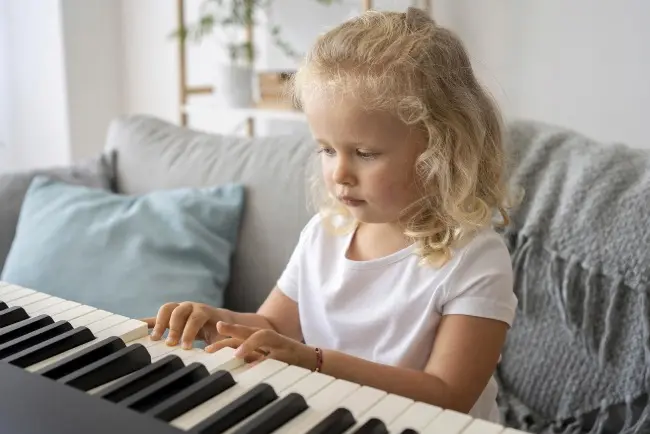
A good hand position lets you play evenly and without extra tension, and it starts with how you sit. In our lessons, the teacher shows how to hold the hands from the very first sessions; for teacher Natalia Rekhtina, hand position is one of the main topics of her online piano lessons. Here is what to know and check at home.
How to Sit
- A bench, not a chair. An ordinary chair nearly always leaves you too low.
- Height. With your fingers on the keys, the line from elbow to knuckles should run level with the floor. If the seat is low, a book or two underneath will help.
- Distance. Keep the elbows a little in front of your body. If they touch your sides, you are too close; if you have to reach out with straight arms, you are too far.
- Back and legs. Sit tall but not rigid, with legs uncrossed and both feet resting flat, either on the floor or a footrest.
- Shoulders. Keep them loose. Children who try hard often hunch them up; ask your child to raise the shoulders as high as possible and let them fall, which makes the difference easy to feel.
The Shape of the Hand
The hand is gently rounded and sits lightly on the keys. To find that shape, rest your palms on your knees with the fingers around the kneecaps, or imagine a small ball in your hand, then move to the keyboard and keep the shape. Flat or stiff fingers make relaxed playing hard. Do not overdo the curve either: you play on the fingertip pads, not the nails. The thumb meets the key slightly on its side.
The Wrist
At rest, the wrist is level and in line with the forearm. While you play, it naturally lifts and dips, but it should start and finish in a level, easy position.
Guidelines for Children
- Starting age. Children aged 5 to 6 have a preparatory level with us: the teacher introduces the keyboard and shows how to hold the hands while playing.
- Practice time. In the early stage, 15 to 20 minutes a day is enough.
- Seat height. A child usually needs a higher bench than an adult so the forearm lies level, plus a footrest if the feet do not reach the floor.
Making It Stick
In an online lesson, the teacher sees your hands and the keys on camera and corrects your posture and finger position on the spot. At home, exercises help lock it in; see Top 5 Exercises for Developing Finger Technique. For how professional pianists practice, see Pianists’ Secrets: How the Best Performers Practice. If anything hurts while you play, stop and tell your teacher; if the pain does not go away, see a doctor.
How to Get Started
In our piano course, students develop hand coordination and finger agility, learn to read music and play classical pieces alongside jazz and pop songs. The teacher picks pieces that match each student’s abilities and tastes, and a finished piece can be played at one of our online concerts or competitions. Lessons are open to students from age 5. A trial lesson costs $8: it is individual and lasts 45 minutes. More about the course is on the Piano page.


