Plasticine or Clay: What to Choose for Your Child
· Updated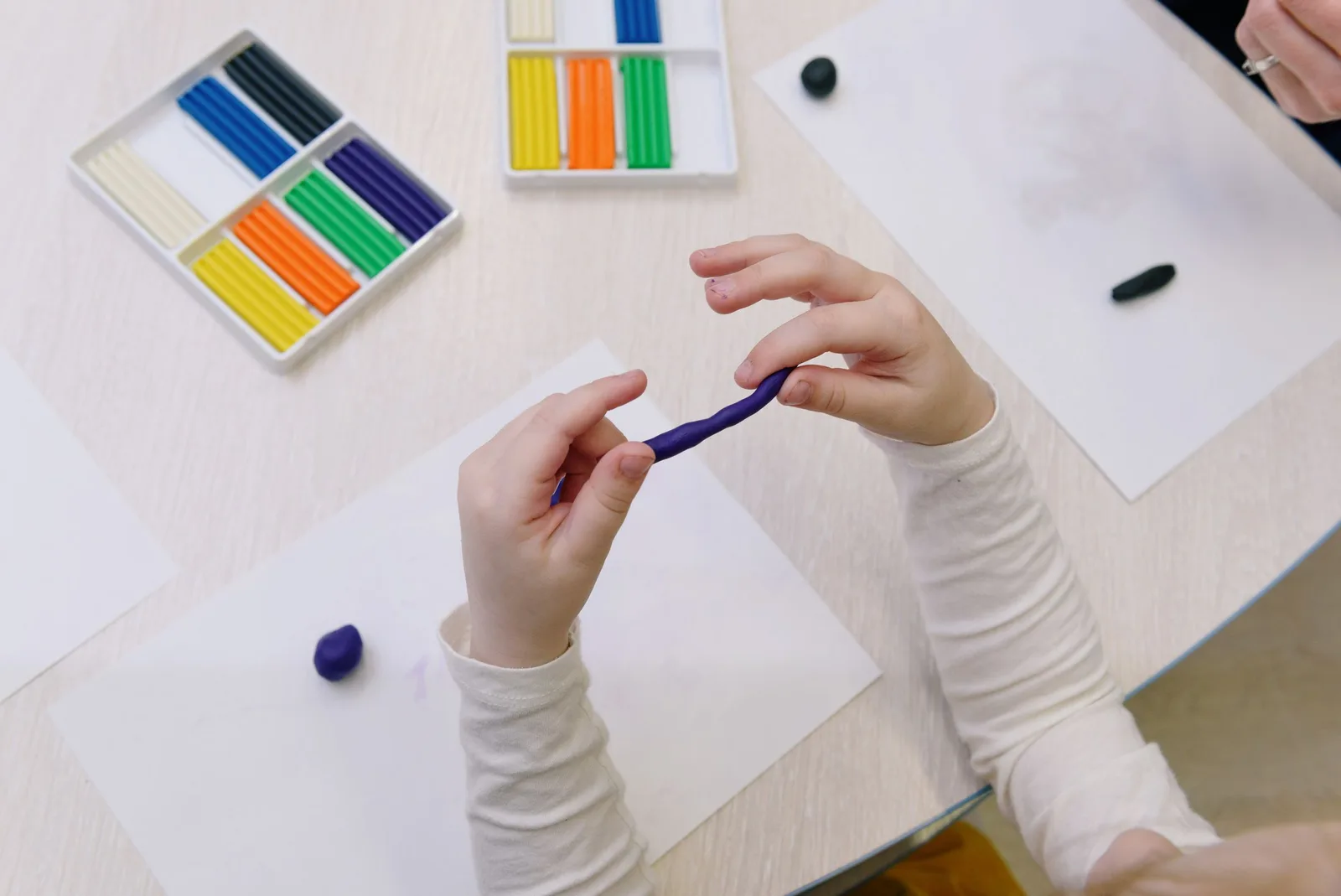
Plasticine and clay are the first modeling materials most children meet, but they behave differently: one never sets, while the other hardens and can become ceramic. Below is how they differ, which is handier for a child’s first pieces and which suits work worth keeping.
Plasticine
Plasticine is a soft modeling compound based on calcium salts, petroleum jelly and fatty acids. Its key feature is that it never dries, so a piece can be reworked endlessly and the material reused. That is why animators love it; Nick Park’s Oscar-winning films were made with it. Plasticine cannot be fired: it melts when heated and can catch fire at high temperatures. One of the first such compounds was invented in 1880 by Franz Kolb, a Munich pharmacist, for sculptor friends whose clay dried out too fast.
Clay
Clay is pliable while wet and turns hard but brittle once dry. To make a piece strong, it is fired at a high temperature, which turns it into ceramics, from terra cotta and earthenware to stoneware and porcelain. Clay has to be worked fairly quickly and kept moist, or it dries out and cracks.
How They Differ
- Setting: plasticine does not set, while clay dries and hardens.
- Reuse: plasticine can be squashed and shaped again, but fired clay cannot.
- Temperature: plasticine softens in warmth and stiffens in the cold, so knead it in your hands first; clay needs moisture.
- Result: clay gives you an object that lasts for years, while a plasticine figure stays soft and dents easily.
What to Choose for Your Child
- For first steps, bright figures and experiments, plasticine is handy: mistakes are easy to fix, and colors blend.
- For a piece worth keeping or giving as a gift, clay is better, since it holds its shape once dry and becomes strong after firing.
- The youngest children are often given soft play dough made of flour, salt and water, which, unlike plasticine, dries out in the air.
What children learn when they sculpt is covered in How Sculpting Develops Children’s Creative Abilities.
Sculpting in Our Course
In lessons, students sculpt with both clay and plasticine and also work with plaster, learning how each material behaves and starting with simple figures. Materials and first techniques are covered in Basics of Modeling: Where to Start for a Beginner.
Our Modeling and Sculpture Course
In our sculpting lessons, students work with clay, plasticine and plaster: they learn to shape the material, join pieces and use sculpting tools, starting with simple figures and gradually moving on to compositions. Lessons are open to students from age 5. A trial lesson costs $8: it is individual and lasts 45 minutes. More about the course is on the Modeling and Sculpture page.


