Geometry for Teens: Tips for Teachers and Parents
· Updated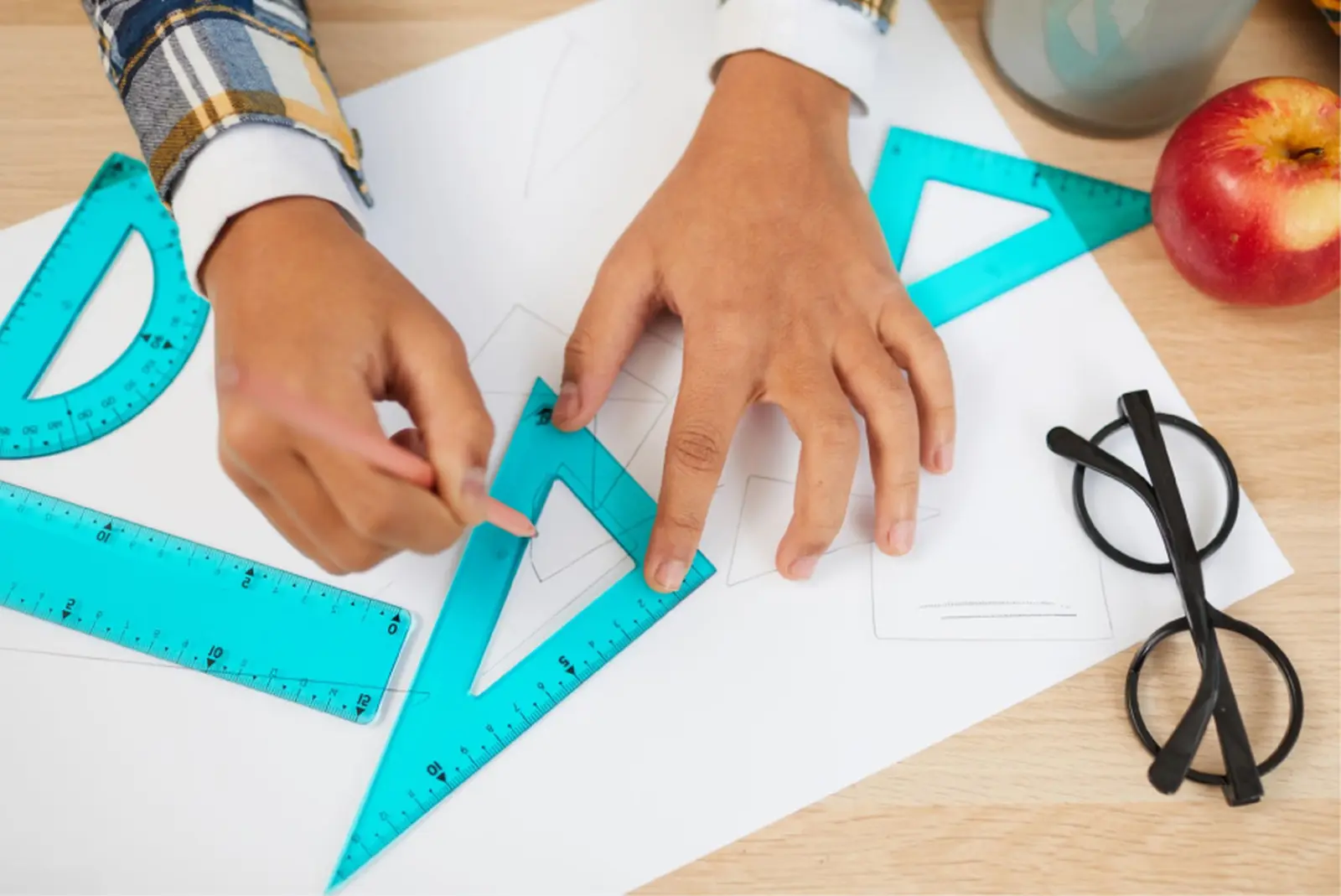
Hearing a theorem is not enough for a teenager: they need to see for themselves that it works and understand why it matters. Here is how teachers and parents can help: what to explain, how to work with diagrams and which tasks to try in GeoGebra, a free interactive geometry app.
Start with Why
Open a topic with a real question: how do you find the area of an oddly shaped room, how steep should a staircase be, why are wheels round? Questions like these show that geometry is about calculation and proof, not a pile of formulas. For examples, see Why Geometry Matters: Its Importance and Benefits.
Diagrams and Tools
One careful diagram beats three sloppy ones. Let teens construct figures themselves with a ruler, compass and protractor, on paper or in an app. A good rule: every step of a solution comes with a reason it is valid. That is how our students learn to write proofs, with the teacher explaining when and why a given theorem applies.
Tasks in GeoGebra
GeoGebra runs on computers, phones and in the browser. Its strength is that you can drag the vertices of a figure and the measurements update at once. Five tasks:
- Angle sum of a triangle. Build a triangle, measure its three angles and display their sum. Drag the vertices: the total stays at 180°.
- Midsegment. Pick two sides of a triangle, mark the middle of each and join those points. Compare that segment with the third side: it stays parallel to it and half as long, wherever the vertices go.
- Inscribed angle. Draw a circle and three points on it, then measure the angle at the third point. Slide it around the circle without crossing the other two points: the angle holds steady at half the central angle on the same arc.
- Transformations. Reflect a triangle across a line, rotate it by 90° and compare the vertex coordinates with the rules in Geometric Transformations: Rules and Examples.
- A conjecture. Let the teen propose a pattern, such as “what if we join the midpoints of a quadrilateral’s sides?”, and test it by dragging points. If it holds, it is worth proving.
Talking About Difficulties
- Gaps. When a new topic stalls, the cause is often older material, such as forgotten properties of figures or theorems. Go back to it.
- Time to think. Hold back the hint and let them try another approach.
- Effort over speed. Notice the work, not only the right answers.
How to Get Started
In our geometry course, students get to grips with the properties of figures and with theorems, learn to solve problems on their own and justify the solution, and prepare for tests, exams and olympiads. Lessons are open to students from age 13. A trial lesson costs $8.00: it is individual and lasts 45 minutes. More about the course is on the Geometry page.


