High School Physics in the US: Courses and AP Physics
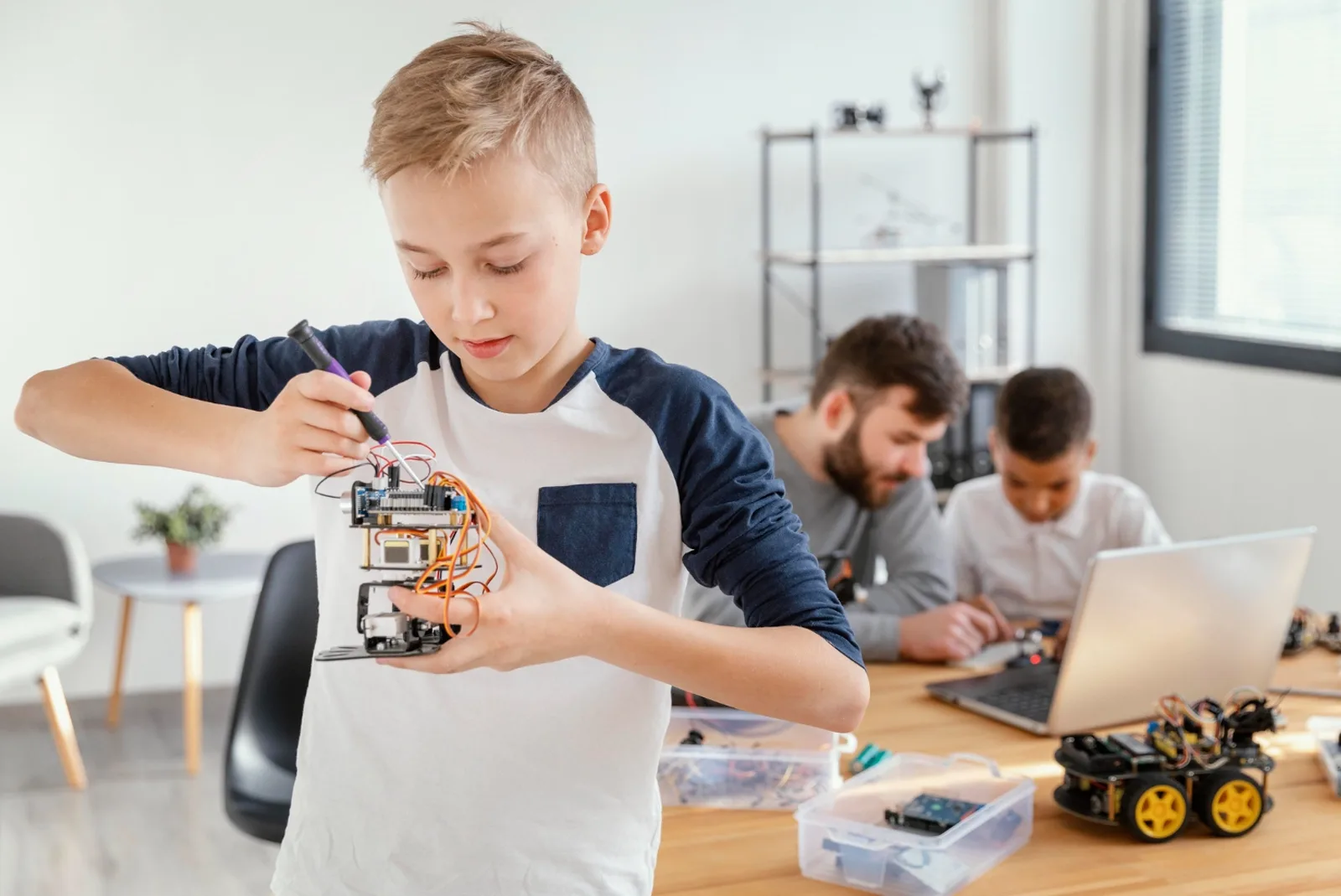
If your child attends an American school, physics works differently there than in Ukraine, with its own standards, its own courses and AP exams that can count toward college. Below is how high school physics is organized in the US, which AP Physics courses exist, how the AP Physics 1 exam works and how it is scored.
Standards: Each State Decides
The US has no single nationwide science curriculum, since standards are adopted state by state. Many states rely on the Next Generation Science Standards (NGSS), written by 26 states together with professional science organizations and finalized in April 2013. By March 2023, 20 states and the District of Columbia had adopted them. The NGSS favor depth over breadth: understanding core science ideas, forming and testing hypotheses and weighing evidence.
AP Physics Courses
AP (Advanced Placement) courses are college-level classes taken in high school, each ending with a College Board exam in May. There are four in physics:
- AP Physics 1: Algebra-Based matches the first semester of an introductory college physics course that uses algebra rather than calculus. Students should have finished geometry and be taking Algebra II at the same time.
- AP Physics 2: Algebra-Based is the second semester at the same level and calls for AP Physics 1 or a similar course, plus precalculus taken earlier or alongside it.
- AP Physics C: Mechanics is a one-semester, calculus-based mechanics course for students who have taken calculus or are taking it at the same time.
- AP Physics C: Electricity and Magnetism is a calculus-based course on electricity and magnetism that follows calculus-based mechanics.
What AP Physics 1 Covers
- Kinematics.
- Force and translational dynamics.
- Work, energy and power.
- Linear momentum.
- Torque and rotational dynamics.
- Energy and momentum of rotating systems.
- Oscillations.
- Fluids.
Teachers may arrange the units in a different order, and students explore the topics through hands-on lab work.
The AP Physics 1 Exam
The 2027 exam takes place on May 5. The exam is hybrid and digital: students answer the multiple-choice questions in the Bluebook app and write their free-response answers by hand in a paper booklet. From May 2027, the exam has a new count of multiple-choice questions and new timing for both sections:
- Section I has 42 multiple-choice questions, takes 85 minutes and counts for half the score;
- Section II has 4 free-response questions, takes 95 minutes and counts for the other half, with one question of each type: a mathematical routine, a translation between representations such as graphs, equations and diagrams, an experimental design and analysis task and a qualitative-quantitative translation.
Calculators are allowed, and reference materials are provided.
How It Is Scored
AP results are reported on a scale from 1 to 5. Many US colleges give credit or let students skip the matching course for a score of 3 or higher, but each college sets its own policy.
How to Prepare
- Work through free-response questions from past exams, which the College Board publishes.
- Take a test preview in the Bluebook app so the format feels familiar.
- Look over the reference materials ahead of time so you do not waste exam time hunting for formulas.
- Practice your pace: in Section I, you have about two minutes per question on average.
In our lessons for students at US schools, the teacher works from the program of the child’s own school, helps with homework and, before tests and exams, reviews the topics that matter, including the question formats and what a well-presented answer looks like. We schedule lessons around the student’s time zone.
Reading motion graphs matters here, since one AP Physics 1 task checks translation between graphs, equations and diagrams; it is covered in Motion Graphs in Physics: How to Read Them, and supporting your child at home in How to Help Your Child with Physics: Tips for Parents.
Our Physics Course
In our physics course, the teacher works from the curriculum of the student’s own school, Ukrainian or American, explains each topic and goes through examples together with the student, who then solves similar problems alone and walks through the solution. We help with homework and get students ready for quizzes, tests and exams. Lessons are open to students from age 13, and we suggest two lessons a week. A trial lesson costs $8: it is individual and lasts 45 minutes. More about the course is on the Physics page.


