Pre-Writing Skills: Hand Exercises for Preschoolers
· Updated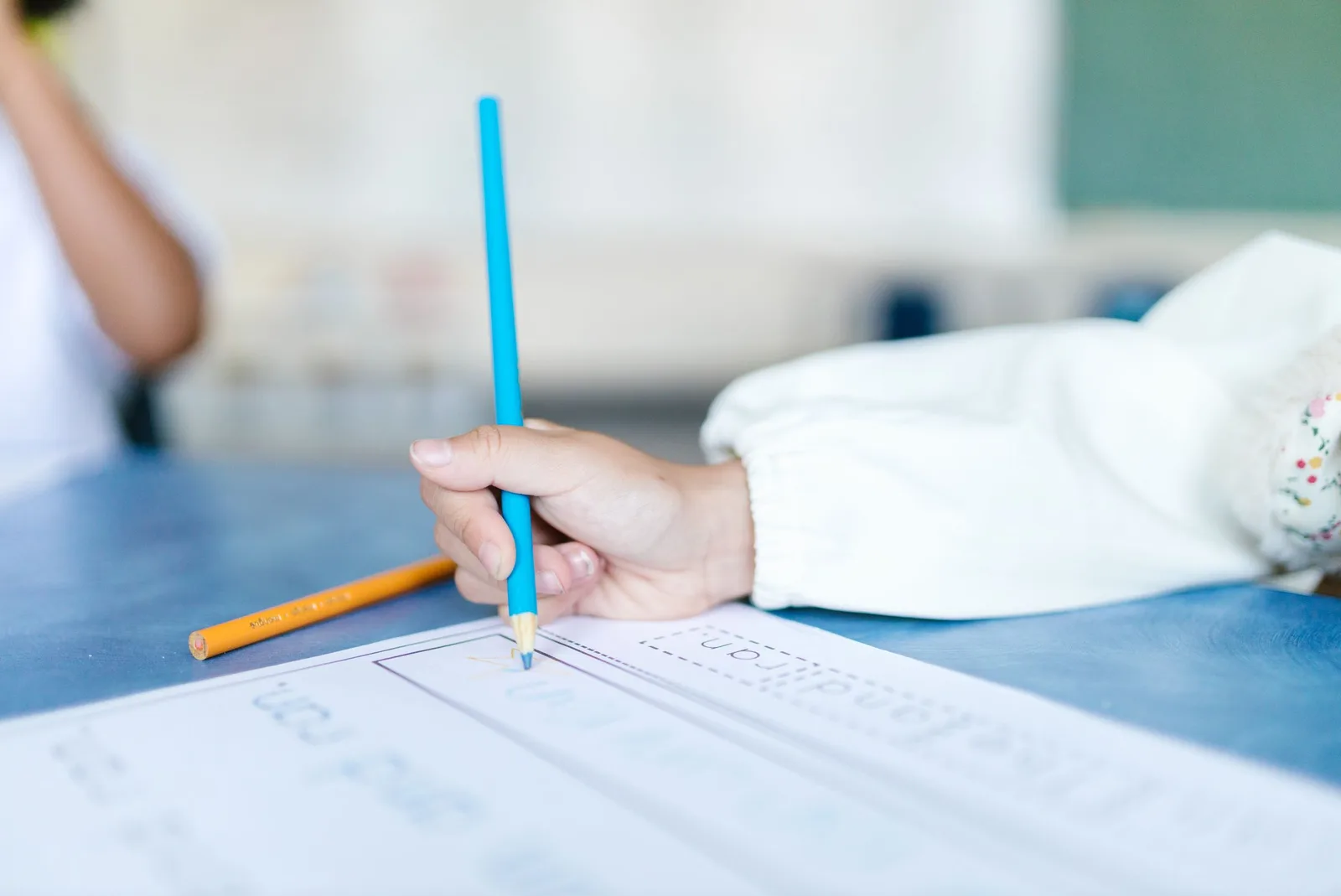
Before a child can write letters, the hand has to learn small, precise movements: holding a pencil, drawing a line, cutting with scissors. Below is what fine motor skills are, how children learn to hold a pencil, what they can usually do by ages five to seven and which exercises help get the hand ready for writing.
What Fine Motor Skills Are
Fine motor skills are the coordinated, precise movements of the fingers and hands, guided by the eyes. They are needed every day, to fasten a button, put together a mosaic, draw and, later, write. They grow with age and practice, and the basic ones usually come together between ages 6 and 12.
How a Child Holds a Pencil
In the preschool years, a child holds a pencil with three fingers, the thumb, index and middle finger, in what is called a static tripod grasp. The next stage is the dynamic tripod grasp, which proper writing calls for and which shapes how precisely the child holds and controls the pencil. By preschool age, one hand already leads in most activities.
What a Preschooler Can Do
A preschooler can usually:
- cut out paper shapes;
- draw and trace vertical lines with crayons;
- button up clothes;
- pick up small objects.
Between five and seven, the elbows and shoulders do less and less of the work, and both hands move smoothly together. A child can now use scissors accurately, say, to cut out a square, write more neatly on lined paper and form printed letters and digits more clearly.
Exercises for the Hand
- Modeling with play dough, plasticine or clay.
- Small pieces: mosaics, puzzles, building sets and beads.
- Finger games.
- Cutting and gluing paper, and finger painting.
- Sorting geometric shapes and laying out patterns.
- Drawing lines and patterns, and tracing shapes and parts of letters.
- Buttoning and folding clothes.
Choose tasks your child can manage, involve different senses, such as sight, touch and hearing, and step in gently when something is being done the wrong way.
Why It Matters for School
The movements of handwriting help children organize what they perceive and recognize letters more easily, because they build a sense of space. Writing is also harder for a child than speaking, and to support learning, it has to become familiar and close to automatic. That is why the hand is prepared ahead of time, before school starts.
When to Ask a Specialist
If your child clearly struggles to use scissors, draw lines or fold clothes, it may point to weak hand–eye coordination. In that case, talk to a specialist: occupational therapy can help develop fine motor skills.
More activities for 5- and 6-year-olds are in Preparing for School: Developmental Activities for 5- to 6-Year-Olds, and how school preparation works as a whole is covered in How to Prepare Your Child for School: A Guide for Parents.
Our School Preparation Course
In our school preparation course, children get to know letters and their sounds and start reading syllables and short words, count and compare quantities, tell shapes apart, describe pictures and make up short stories, get their hand ready for writing and learn to work on tasks on their own. We prepare children for schools in Ukraine and in the US, with lessons in English, Ukrainian or Russian. Lessons are open to children from age 5, and we suggest two lessons a week. A trial lesson costs $8: it is individual and lasts 45 minutes. More about the course is on the School Preparation page.


