How to Teach a Preschooler to Count to 10 and 20
· Updated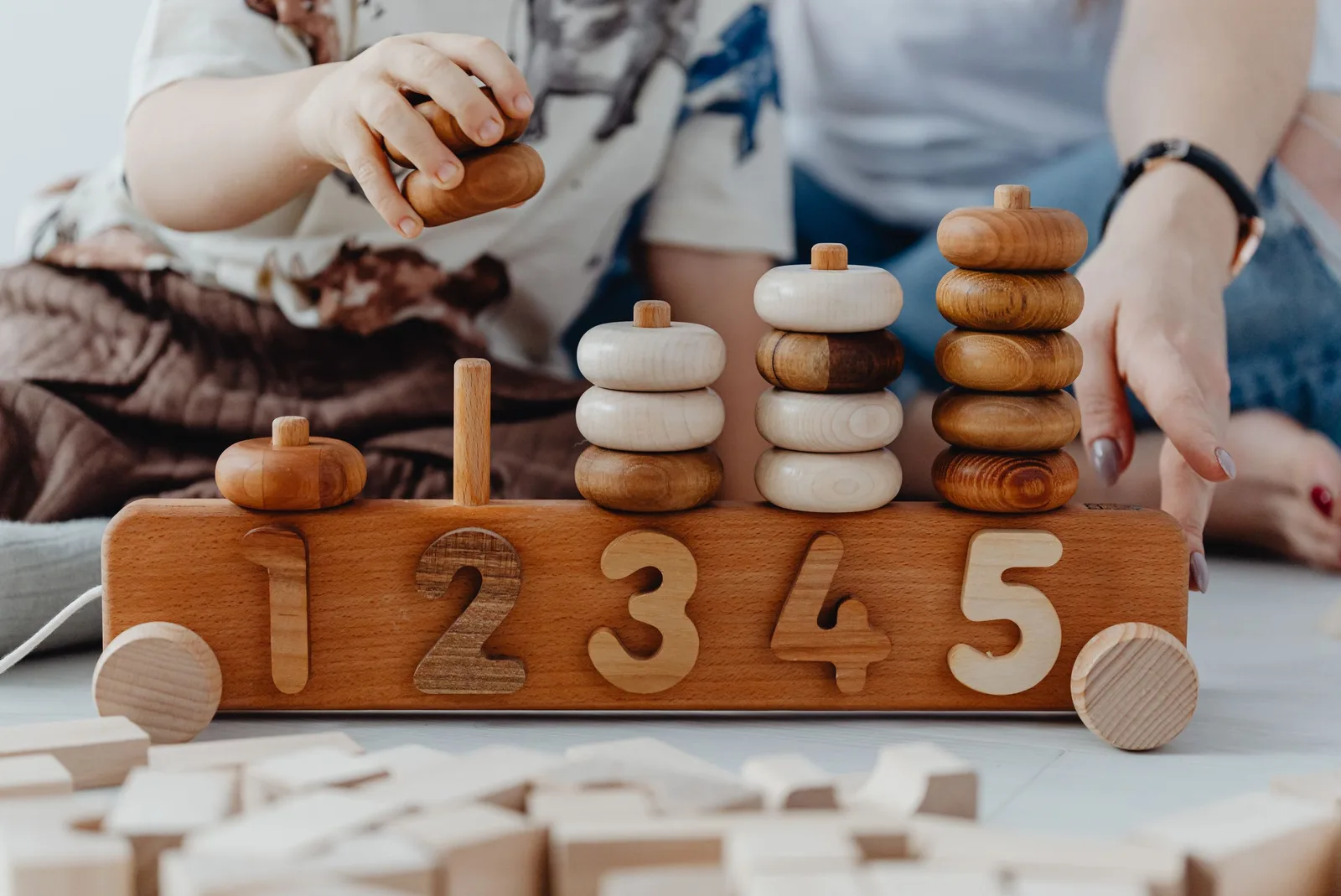
Children start saying “one, two, three” long before school, but reciting numbers in order and knowing how many things are in front of you are different skills. Below is what counting involves, how to teach it step by step up to 10 and then to 20, and which counting games to play at home.
What Counting Really Means
From about age two, children gradually pick up the order of number words, first a short stretch and then a longer one. At first a child may recite “one, two, three” with no idea what each word stands for. But counting takes more than memorizing the list. Psychologists describe several counting principles:
- Stable order: number words always come in the same sequence. A child who says “one, two, four” cannot get the right total.
- One-to-one: each object gets one number word, with none skipped and none counted twice.
- Cardinality: the last number word said is the answer to “how many?”
- Abstraction: anything can be counted, from toys to steps to claps.
- Order irrelevance: whichever object you start with, the total stays the same.
Small Amounts at a Glance
People see small amounts, usually up to four items, instantly, without counting. Even babies have this ability, and it grows with age. More than four or five items cannot be taken in at a glance unless they form a familiar pattern, like the six dots on a die. That is why dice and dot cards work well for first games.
Up to 10, Step by Step
- Learn the order of numbers through rhymes and songs, on walks, on the stairs or while clapping.
- Count objects by touching each one or moving it aside, so nothing gets skipped or counted twice.
- After counting, ask “How many are there?” The answer is the last number said.
- Ask your child to count out a set amount: “Give me five spoons.”
- Compare groups: which has more, which has fewer and which are the same.
- Show the numeral next to the matching number of objects, and present zero as “none at all.”
Up to 20 and Beyond
Once counting to 10 is solid, move on to the teens. A useful benchmark is the Common Core standard for kindergarten, the year that children in most American schools start at five. During that year, children learn to:
- count to 100 by ones and by tens;
- answer “how many?” by counting up to 20 objects in a line, a rectangle or a circle, or up to 10 scattered ones;
- count out the right number of objects for any number from 1 to 20;
- write the numbers from 0 to 20;
- compare two written numbers between 1 and 10;
- add and subtract within 10 using objects or drawings.
Start with objects laid out in a row: for scattered objects, the standard expects counting only up to 10.
Counting Games at Home
- Count on fingers: it is handy for small numbers and simple sums, and children do it on their own anyway.
- Play board games with a die: your child recognizes the dots and counts out the moves.
- When setting the table, ask your child to put out one spoon for each family member.
- Count stairs, cars in the parking lot or buttons on a sweater.
- Compare piles: “Which pile has more nuts?” Guess first, then count to check.
What else is useful to know before first grade is covered in What a Child Should Know and Be Able to Do Before First Grade, and activities for 5- and 6-year-olds are collected in Preparing for School: Developmental Activities for 5- to 6-Year-Olds.
Our School Preparation Course
In our school preparation course, children get to know letters and their sounds and start reading syllables and short words, count and compare quantities, tell shapes apart, describe pictures and make up short stories, get their hand ready for writing and learn to work on tasks on their own. We prepare children for schools in Ukraine and in the US, with lessons in English, Ukrainian or Russian. Lessons are open to children from age 5, and we suggest two lessons a week. A trial lesson costs $8: it is individual and lasts 45 minutes. More about the course is on the School Preparation page.


