Easy Physics Experiments to Do Safely at Home
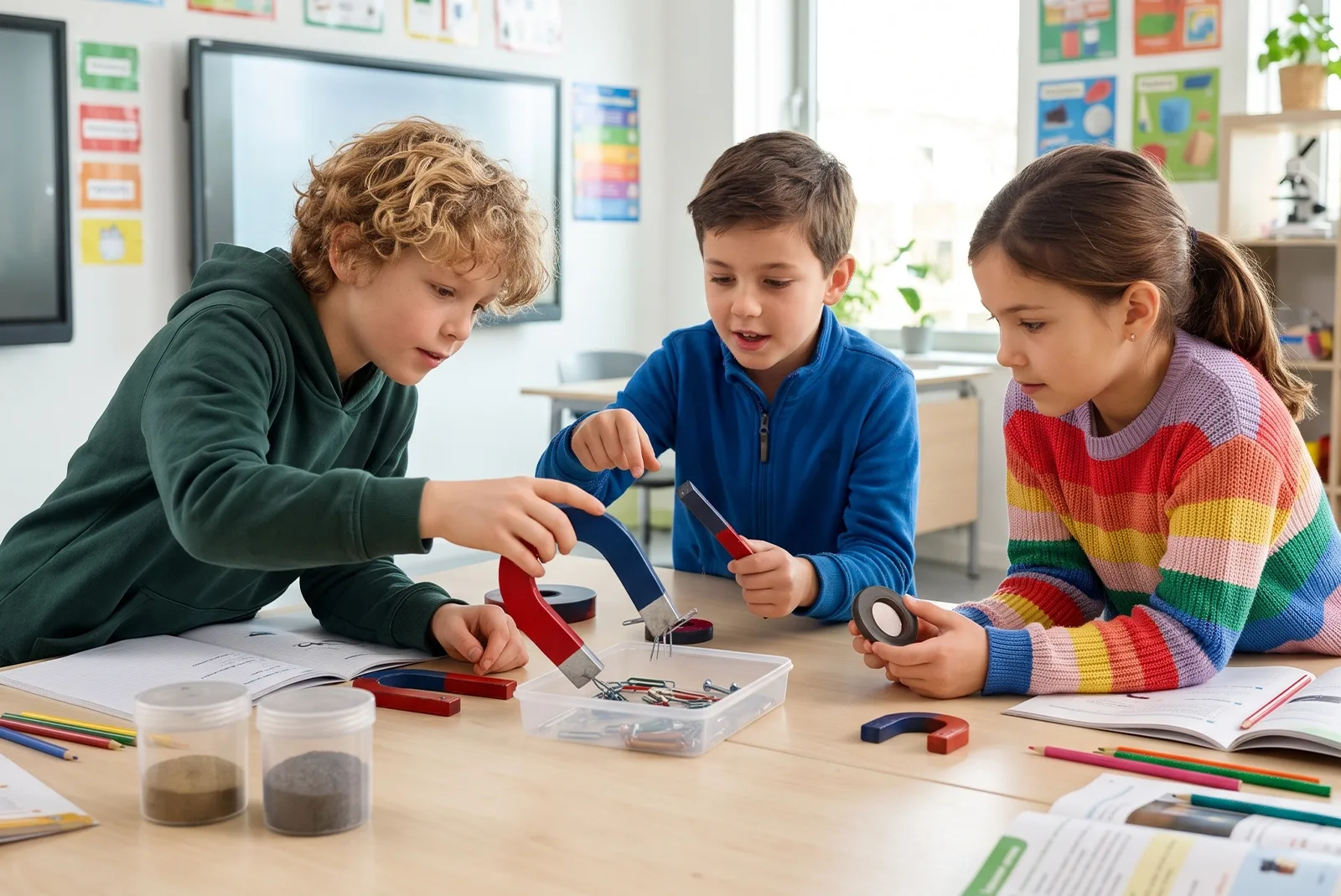
Physics makes the most sense when you see it with your own eyes, and many textbook effects can be shown at home with simple objects. Below are five safe experiments, with a magnet, a lemon, a pendulum, a glass of water and a bottle, along with what happens in each and how to record your results.
Safety Rules
- Do the experiments together with an adult.
- No outlets, household current or open flames: everything below works without them.
- Never taste any of the materials.
- Clean up afterward and wash your hands.
1. A Magnet and Iron Filings
Place a magnet under a sheet of paper or cardboard, sprinkle a few iron filings on top and tap the sheet gently. The filings line up in patterns around the magnet. Iron is ferromagnetic, so in the magnet’s field each grain turns into a tiny magnet of its own and pulls on its neighbors, and the chains of filings settle along the magnetic field. That is how the experiment reveals the direction of the field.
2. A Lemon Battery
Push a zinc-coated (galvanized) nail and a strip of copper, for instance copper wire, into a lemon and connect them with wires to a multimeter: a single lemon gives about 0.9 V. To light an LED, connect several lemons in series, which raises the voltage. Zinc and copper act as the electrodes and the lemon juice as the electrolyte, so a chemical reaction inside turns the lemon into a battery. Alessandro Volta built a similar battery in 1800, with salt water in place of lemon juice. Try two identical nails and you will get no voltage, while the current depends on how big the electrodes are, how deep they go and how far apart they sit.
3. A Pendulum
Tie a small weight to a string and fix the other end. Pull the weight a little to the side, let go and use a stopwatch to time 10 full swings. Then try a heavier weight, and after that change the length of the string. You will see that the time of a swing does not depend on the weight but does depend on the length. For small swings, it barely depends on how far you pull the pendulum, a property that makes pendulum clocks possible.
4. The “Broken” Pencil
Stand a pencil at a slant in a glass of water and look from the side: at the water’s surface, it seems to snap. This is refraction, as light changes direction when it passes from water into air, because it travels more slowly in water than in air.
5. The Cartesian Diver
Fill a plastic bottle to the top with water, drop in an eyedropper holding just enough air to barely float and screw the cap on tight. Squeeze the bottle and the “diver” sinks; let go and it rises. Squeezing raises the pressure in the bottle, the air in the dropper gets compressed, more water flows in and the dropper becomes heavier. The experiment shows Archimedes’ principle and how pressure changes the volume of a gas. Raffaello Magiotti first described it in 1648, and the experiment takes its name from René Descartes.
How to Record Your Results
- Before the experiment, write down what you think will happen.
- During it, write down your measurements, such as time, length or voltage.
- Afterward, compare the result with your prediction and explain it using a law from your textbook.
Discussing experiments, the effects students observe and the results of measurements, and learning to draw conclusions, is part of our physics lessons.
How current and voltage relate in the lemon battery is covered in Ohm’s Law: Current, Voltage and Resistance, and recording measurements in the right units in Units in Physics: The SI System and Unit Conversion.
Our Physics Course
In our physics course, the teacher works from the curriculum of the student’s own school, Ukrainian or American, explains each topic and goes through examples together with the student, who then solves similar problems alone and walks through the solution. We help with homework and get students ready for quizzes, tests and exams. Lessons are open to students from age 13, and we suggest two lessons a week. A trial lesson costs $8: it is individual and lasts 45 minutes. More about the course is on the Physics page.


