How the Recorder Makes Its Sound: Labium, Registers, Overtones
· Updated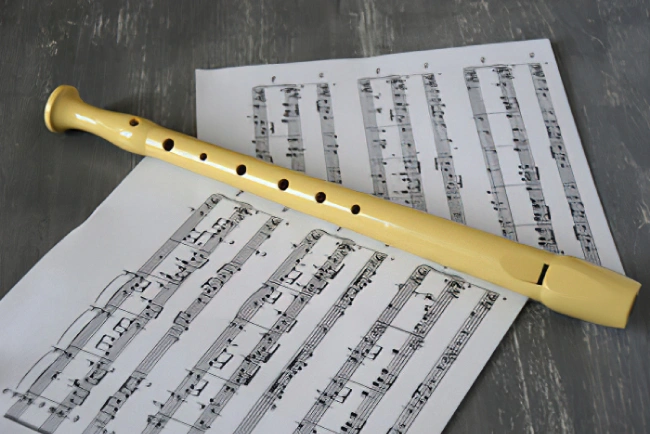
The recorder has a soft, clear sound, and there is a physical reason for it. Here is how that sound is produced, what registers are and why its tone is so recognizable. How the recorder supports children’s musical development is covered in Children’s Musical Development with the Recorder.
A Whistle with Finger Holes
A recorder works like a whistle, or like the flue pipes of an organ. The player blows into a slim channel at the top of the instrument, and the airstream crosses a gap, the window, and hits a sharp lip known as the labium. The stream flips back and forth above and below the labium and sets the air inside the tube vibrating. The tube’s own resonance keeps the pitch steady.
Registers
The air in the tube vibrates rather like a string, in several ways at once. The pitch you hear is the lowest and usually loudest of these vibrations; the others are overtones. Players sort notes by register: a note in the first register has one node of vibration in the tube, one in the second has two, and so on. Blow faster and the lower vibrations turn unstable, so the sound jumps to the next register, which is called overblowing.
Why the Sound Is Soft
The recorder’s sound has few high overtones; among the rest, odd ones dominate and even ones are almost missing, although this varies between instruments and fingerings. Because high overtones are scarce, writers since Michael Praetorius have noted that the ear struggles to tell which octave a recorder is playing in.
Air and Pitch
The speed of the airstream also changes the pitch: faster air gives a higher note, up to a point. So blowing harder makes a note sharp, and blowing gently makes it flat. The sound also depends on the shape of the channel and window, which the maker adjusts while building the instrument, and on how the player blows. The recorder needs only very low air pressure, so what matters most is a long, even, controlled breath out. Breathing for the recorder is covered in Breathing Techniques in Recorder Playing.
How to Get Started
In our recorder course, students learn to hold the instrument properly and control their breathing, read notes and rhythms, and play favorite melodies and pieces in different styles, with the option of performing at online concerts. Lessons are open to students from age 5. A trial lesson costs $8: it is individual and lasts 45 minutes. More about the course is on the Recorder page.


