Fingerstyle Secrets: How to Play Songs with Your Fingers
· Updated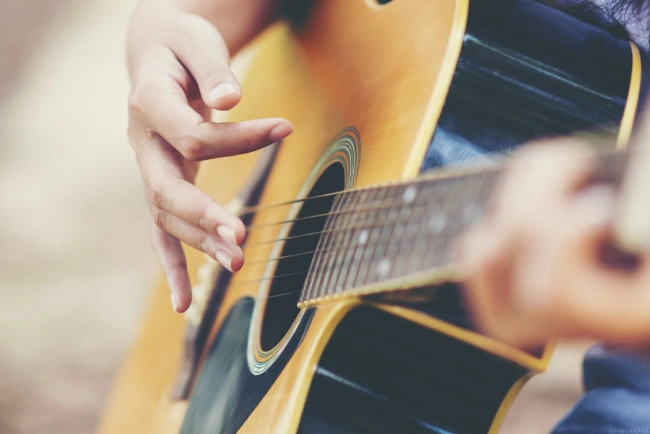
Fingerstyle means playing the guitar with your fingers instead of a pick. The thumb handles the bass while the other fingers play chords and melody, so a single guitar sounds like a small band. Here is how the technique works, three basic patterns, and what it borrows from classical guitar.
The Right-Hand Fingers: p, i, m, a
Guitar music marks the right-hand fingers with the first letters of their Spanish names: p for the thumb (pulgar), i for the index (índice), m for the middle (medio) and a for the ring finger (anular). These labels come from classical guitar and are used in fingerstyle too. The thumb usually covers the three bass strings, while i, m and a take the three top strings.
Three Basic Patterns
- The p–i–m–a arpeggio. Hold an A minor chord. The thumb plays the fifth string, then i, m and a play the third, second and first strings in turn. The chord tones follow one another, as in classical études.
- Alternating bass. The thumb steadily switches between two bass strings on every beat, say the fifth and fourth strings in C major. Once the bass runs on its own, the index and middle fingers add melody notes on the top strings between thumb strokes. This pattern is called Travis picking, after the American guitarist Merle Travis.
- The pinch. The thumb and one finger, usually m, play a bass note and a melody note at the same moment. It brings out strong beats and lifts the melody above the accompaniment.
Practice each pattern slowly with a metronome first: evenness matters more than speed.
What Fingerstyle Borrows from Classical Guitar
Classical technique uses two kinds of stroke. In a rest stroke (apoyando), the finger comes to rest on the next string after plucking; it is used to bring out a melody. In a free stroke (tirando), the finger passes over the next string without touching it; it is the main stroke for chords and arpeggios. Alternating i and m in melodies, a steady thumb bass and reading music help in any style.
Techniques That Add Color
- Percussion. Many fingerstyle players tap the guitar body, adding rhythm to the melody and bass.
- Slurs. Hammer-ons and pull-offs with the fretting hand make notes sound without plucking.
- Alternate tunings. Many fingerstyle players retune the guitar, for example to drop D (the sixth string lowered to D) or open G.
Every pattern rests on independent, responsive fingers. Exercises for them are collected in Finger Exercises: Dexterity and Strength for Guitarists. To hear how it all sounds, listen to recordings by Chet Atkins and Merle Travis.
How to Get Started
In our classical guitar course, students develop hand position and playing techniques, work on finger coordination and tone quality, and learn to read music. The teacher builds the program around each student’s level and interests. Lessons are open to students from age 6. A trial lesson costs $8.00: it is individual and lasts 45 minutes. More about the course is on the Classical Guitar page.


