Which Guitar for a Child: Three Types and Sizes
· Updated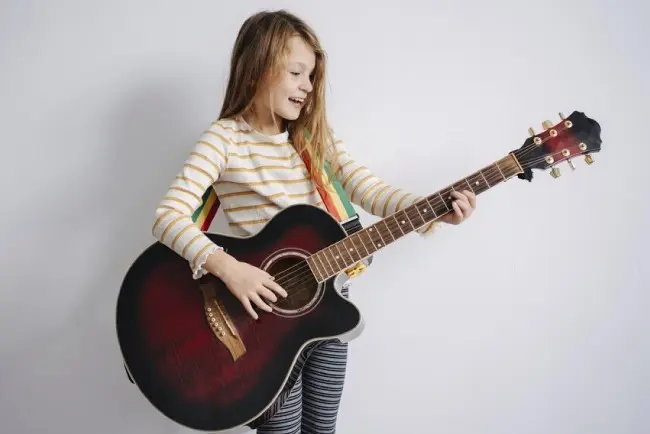
Your child wants to play the guitar, but which one should you buy? There are three main kinds, and they differ noticeably in strings, sound and the way they are learned. Here is a look at each, plus help with choosing the size.
Classical Guitar
It has nylon strings, which used to be made of gut. A classical guitar rests on the left leg, raised on a footrest, and is played with the fingers, using the nails or fingertips to pluck individual strings. It has a large repertoire of its own: classical music as well as jazz and contemporary pieces. Its right-hand technique is more demanding, which is why acoustic and electric guitars are often seen as easier to start on. The five basics of classical guitar are covered in Five Classical Guitar Basics: Posture, Fingers, Plucking.
Steel-String Acoustic Guitar
Steel strings pull much harder, so the body is built sturdier and a metal rod runs inside the neck. The body is usually larger than a classical guitar’s, and it is more often played standing, with a strap. The smallest body, the parlor, is comfortable to play and suits small rooms and young players, although it is quieter than bigger models. Choosing strings is covered in How to Choose Guitar Strings: A Practical Guide.
Electric Guitar
Without an amplifier an electric guitar can barely be heard: pickups turn the string vibrations into an electrical signal that comes out of a speaker. The tone can be changed with the guitar’s knobs, the amp settings and effects such as distortion. Since the 1950s and 1960s it has been the leading instrument of popular music, from pop and rock to blues and jazz. Lessons need a guitar, an amplifier and a cable.
How to Choose
- By the music your child likes. Classical and pieces in various styles call for a classical guitar; campfire songs for an acoustic; rock for an electric.
- By size. As a guide by age: under 6, a 1/4 guitar; under 8, a 1/2; from 8 to 12, a 3/4; from 12, a full-size 4/4. Height and hand size matter more, so try the guitar in a shop: it should sit comfortably with your child, whose hand must wrap around the neck and reach every string.
- By budget. An expensive guitar is not needed for first lessons; what matters is that it is comfortable, has a pleasant sound and holds its tuning.
How to Get Started
In our classical guitar course, students develop hand position and playing techniques, work on finger coordination and tone quality, and learn to read music. The teacher builds the program around each student’s level and interests. Lessons are open to students from age 6. A trial lesson costs $8: it is individual and lasts 45 minutes. More about the course is on the Classical Guitar page.


