Choosing Your First Bass Guitar: Tips for Beginners
· Updated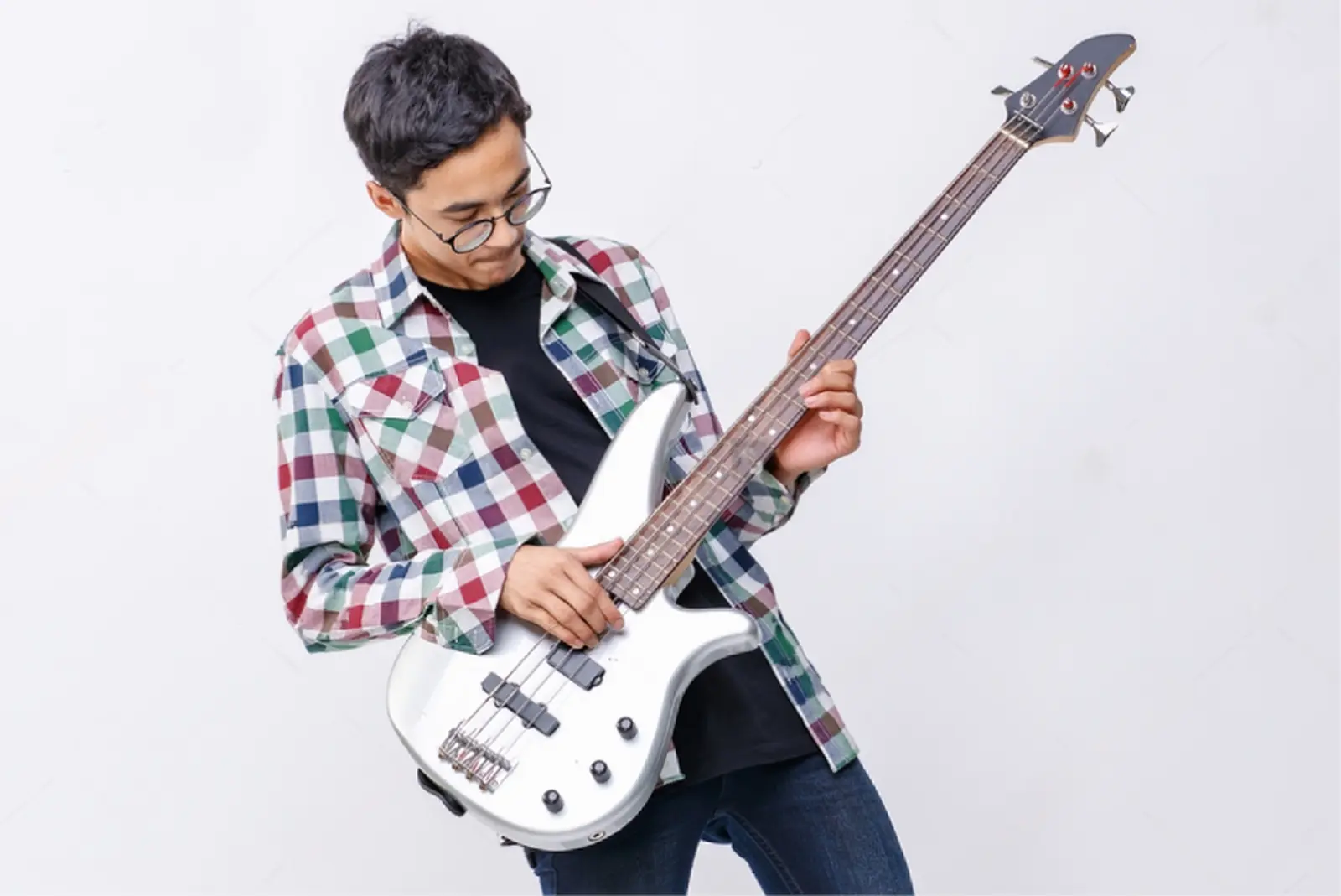
Choose your first bass for comfort: an awkward instrument makes regular practice hard. Below is how many strings you need, which scale length and pickups to pick, what to check when buying, what to get along with the bass and what matters if the instrument is for a child.
Four Strings or Five
Most basses have four strings tuned E, A, D and G; five-string models usually add a low B. A four-string bass is the better start: it is simpler, and its narrower neck is easier on the hands.
Scale Length: Standard, Medium or Short
Scale length is the vibrating length of the string. The standard for the bass guitar became 34 inches (about 86 cm), the scale of the Fender Precision Bass released in 1951. A scale of 30 inches (76 cm) or less counts as short, and 32 inches (81 cm) as medium, which is less common. On a short-scale bass the frets sit closer together, so it suits players who find it hard to reach the frets on a standard one.
Pickups: P and J
Many basses follow one of two classic Fender designs. The Precision Bass (P) has one pickup and a deep, full sound. The Jazz Bass (J), introduced in 1960, has two pickups, a brighter sound with more mids and highs and a neck that is narrower at the nut than the Precision’s. Either works for a beginner, so choose by sound and by how the neck feels in your hand. The models that set the standard are described in 10 Famous Bass Guitars Every Beginner Should Know.
Fretted or Fretless
A bass with no frets on the neck is called fretless. You have to place your fingers precisely by ear, so a fretted bass is the better first instrument.
What to Check When Buying
- Weight and balance: the bass should not be too heavy or dip toward the neck.
- The strings press down easily, and nothing buzzes on open strings or on different frets.
- The neck is straight, the tuners hold the tuning and the electronics do not crackle when you turn the volume and tone knobs.
- If you buy online, check the return policy and, if possible, compare with an instrument you have held in person.
What You Need Along with the Bass
A bass amplifier and a cable, a strap, a tuner and a case. A headphone output on the amp comes in handy for practice at home. For an online lesson, the bass is plugged into the amp, and the amp is placed where the volume is easy to adjust, so the teacher can hear both the instrument and your voice.
If the Bass Is for a Child
Our bass guitar course welcomes children from age 10. What matters most for a child is reaching the first frets while sitting and an instrument that does not tip toward the neck; a short-scale bass is often more comfortable. More details are in Bass Guitar for Kids: What Age to Start and How to Begin.
Tuning and Care
Check the tuning with a tuner before every practice session. When the strings start to sound dull or will not stay in tune, it is time to replace them. If the strings sit high above the neck or buzz, take the instrument to a technician, who can adjust the neck and string height. How to start playing once you have a bass is covered in The Basics of Playing the Bass Guitar: First Steps for Beginners.
Our Bass Guitar Course
In our bass guitar course, students learn hand position and playing techniques, read notation and tablature, learn bass lines in various rock styles and play them over backing tracks, following the drums and keeping a steady tempo. Once a part is ready, students can play it at one of our online concerts or competitions. Lessons are open to students from age 10. A trial lesson costs $8.00: it is individual and lasts 45 minutes. More about the course is on the Bass Guitar page.


